

The 10 Most Famous Companies in the World: Tech Giants Dominating the Global Marketplace
The global business landscape in 2025 is dominated by tech giants that have reached historic valuations. The world's most famous companies are not only leading their sectors, but defining the direction of the global economy. As of October 2025, three companies have surpassed the $4 trillion mark in market capitalisation: Nvidia, Microsoft and Apple.
Nvidia leads the ranking with a market capitalisation of more than $5 trillion. Microsoft and Apple follow, both exceeding $4 trillion. This growth reflects the digital transformation accelerated by artificial intelligence, cloud computing and constant innovation in hardware and software.
Methodology: How are the most famous companies measured?
Market capitalisation is the fundamental method of determining the world's most famous companies. This indicator is calculated by multiplying the total number of outstanding shares by the current price of each share on the stock exchange.
| Market capitalisation = Number of shares outstanding × price per share |
The data come from official sources such as the New York Stock Exchange (NYSE) and NASDAQ. Market capitalisation reflects the market's perception of a company's future value and growth potential, not its actual earnings. Companies with higher market capitalisation tend to have greater liquidity, global brand recognition and a presence in multiple economic sectors. The names of famous companies such as Apple, Microsoft and Nvidia have become synonymous with innovation and business success worldwide.
Top 10 most famous companies: Ranking by market capitalisation
Nvidia Corporation (NVDA) - $5 trillion
Nvidia Corporation made history on 29 October 2025 by becoming the first company in the world to surpass $5 trillion in market capitalisation. The chipmaker reached this valuation after its shares rose 4%, trading as high as $210.90. The company has accumulated a revaluation of more than 50% so far in 2025.
CEO Jensen Huang announced that Nvidia expects to receive orders for $500 billion worth of artificial intelligence chips. In addition, he revealed plans to build seven new supercomputers destined for the US Department of Energy. The company also acquired a $1 billion stake in Nokia for 5G and 6G telecommunications equipment.
Founded in 1993 by Jensen Huang, Chris Malachowsky and Curtis Priem, Nvidia dominates the market for graphics processing units (GPUs) used in artificial intelligence, deep learning, video games and high-performance computing. Its products are critical for autonomous vehicles, data centres and virtual reality.
Microsoft Corporation (MSFT) - $4+ trillion
Microsoft Corporation reclaimed the $4 trillion market capitalisation mark in October 2025. The company founded by Bill Gates in 1975 has undergone a remarkable transformation under the leadership of Satya Nadella, who took over as CEO in 2014.
The recently renewed agreement with OpenAI significantly strengthens its position in artificial intelligence. Microsoft gained a 27% stake in the company that created ChatGPT and retains exclusive rights to the intellectual property until 2032. This agreement includes an Azure cloud computing services contract valued at $250 billion.
Microsoft dominates the enterprise market with products such as Windows, Microsoft Office and LinkedIn. The Xbox gaming platform, Surface tablets and its $10 billion-plus investment in OpenAI demonstrate its commitment to technology innovation. Microsoft's ecosystem ranges from productivity software to cloud infrastructure, cementing its presence in virtually every sector of the digital economy.
Apple Inc. (AAPL) - $4+ trillion
On 28 October 2025, Apple Inc. became the third company to reach $4 trillion in market capitalisation, behind Nvidia and Microsoft. The company's shares hit an intraday high of $269.87, driven by strong demand for the iPhone 17 in China and the United States.
Founded by Steve Jobs in 1976, Apple revolutionised multiple industries with iconic products such as the iPhone, iPad, Mac and Apple Watch. According to Counterpoint Research, sales of the iPhone 17 outsold the previous generation by 14% during the first 10 days of availability in key markets. Apple's stock market value has increased by more than 10% in 2025.
Apple was the first US company to reach a valuation of $1 trillion on 2 August 2018. It subsequently surpassed $2 trillion on 19 August 2020 and $3 trillion on 30 June 2023. The integrated ecosystem of hardware, software and services generates exceptional loyalty among users. Apple's services, including Apple Music, iCloud and Apple TV Plus, represent a high-growth segment that complements its device sales.
Amazon.com Inc (AMZN) - $1.8+ trillion
Amazon.com maintains its position as the fourth-most-valuable company in the world, with a market capitalisation of over $1.8 trillion. Founded by Jeff Bezos in 1994, it evolved from an online bookstore into an e-commerce and cloud computing giant under the leadership of Andy Jassy, who has been CEO since 2021.
Amazon Web Services (AWS) dominates cloud infrastructure and generates the lion's share of operating profits. The company acquired Whole Foods Market and develops Alexa devices. The ecosystem includes third-party logistics and digital advertising that competes with Google and Meta.
Alphabet Inc. (GOOGL), Meta Platforms (META), Tesla Inc. (TSLA): The tech ecosystem
Alphabet Inc., Google's parent company, is approaching $3.3 trillion in market capitalisation. Google dominates Internet search and digital advertising, while YouTube leads in online video. Google Cloud competes with AWS and Azure. CapitalG and GV hold investments in Snap Inc., Lyft and Airbnb.
Meta Platforms Inc., founded by Mark Zuckerberg, has a market capitalisation of more than 1.5 billion. Facebook, Instagram and WhatsApp dominate social networks with more than 3 billion active users. The company recovered more than 400% of its value after pausing its Metaverse operations. Meta also stands out among famous marketing companies, revolutionising digital advertising with advanced targeting algorithms and advertising solutions that generate billions in annual revenue.
Tesla Inc., led by Elon Musk, revolutionised the automotive industry with electric vehicles. It competes with Toyota, Volkswagen, Mercedes-Benz Group, BMW and NIO. Develops autonomous driving and generates revenue through emissions credits.
Factors that determine global corporate fame
The world's most famous companies share fundamental characteristics that transcend their financial valuation. These factors explain why these corporations maintain dominant positions for decades:
- Global brand recognition: Apple, Microsoft and Amazon are known in virtually every country in the world, engendering immediate trust among consumers and investors
- Constant business innovation: Massive investment in research and development that drives sustained success and maintains competitive advantage over rivals
- Significant global impact: They operate on multiple continents, generate employment for millions of people, and their strategic decisions affect entire economies
- Adaptation to technological change: Demonstrated ability to transform according to market needs, such as Microsoft evolving into the cloud or Apple diversifying into services
- Proven visionary leadership: CEOs such as Satya Nadella, Tim Cook, and Jensen Huang define long-term visions that transform entire industries
- Famous companies' values clearly defined: The most successful corporations transparently communicate their purpose, future aspirations and ethical principles that guide their day-to-day operations and strategic decisions
Google processes searches in more than 150 languages daily. Amazon delivers products to dozens of countries in record time. Meta connects billions of users in real time through its platforms. Warren Buffett built Berkshire Hathaway through an unwavering investment discipline based on value and sustainable growth.
Tech dominance: Why tech leads the rankings
The technology sector dominates the ranking with 8 of the top 10 positions. The FAANG companies (Facebook/Meta, Apple, Amazon, Netflix, Google/Alphabet), along with Microsoft and Nvidia, account for more than 50% of the S&P 500's capitalisation.
The semiconductor market is critical. Nvidia and TSMC manufacture chips that power the AI, cloud computing and smart device revolution. Cloud computing generates massive recurring revenue for Microsoft, Amazon and Google. Companies migrate operations to the cloud to reduce costs and increase efficiency.
The technology ecosystem is self-reinforcing through network effects. More users attract more developers, who create more applications, which attract more users. This virtuous circle benefits platforms such as iOS, Android and Windows.
Top 3 companies for beginner investors

For investors starting their journey in the financial markets, three companies stand out for combining stability with growth potential:
- Apple (AAPL): diversified business model with exceptional customer loyalty, regular dividend policy, consistent share repurchases and the world's strongest brand recognition
- Microsoft (MSFT): Dominance in enterprise software with predictable revenue, continued growth in the cloud, massive investment in artificial intelligence, and recurring contracts that generate stability
- Amazon (AMZN): Undisputed leadership in e-commerce, highly profitable AWS that generates the lion's share of operating profits, and services integrated with Prime that create enduring loyalty
These three companies have strong balance sheets, consistent free cash generation and proven management teams. Beginning investors can build a solid portfolio foundation with these companies before exploring riskier investments. To learn more about investment strategies, it's helpful to know the basics of technical analysis and fundamental analysis.
Latin American investment guide: Accessing global markets
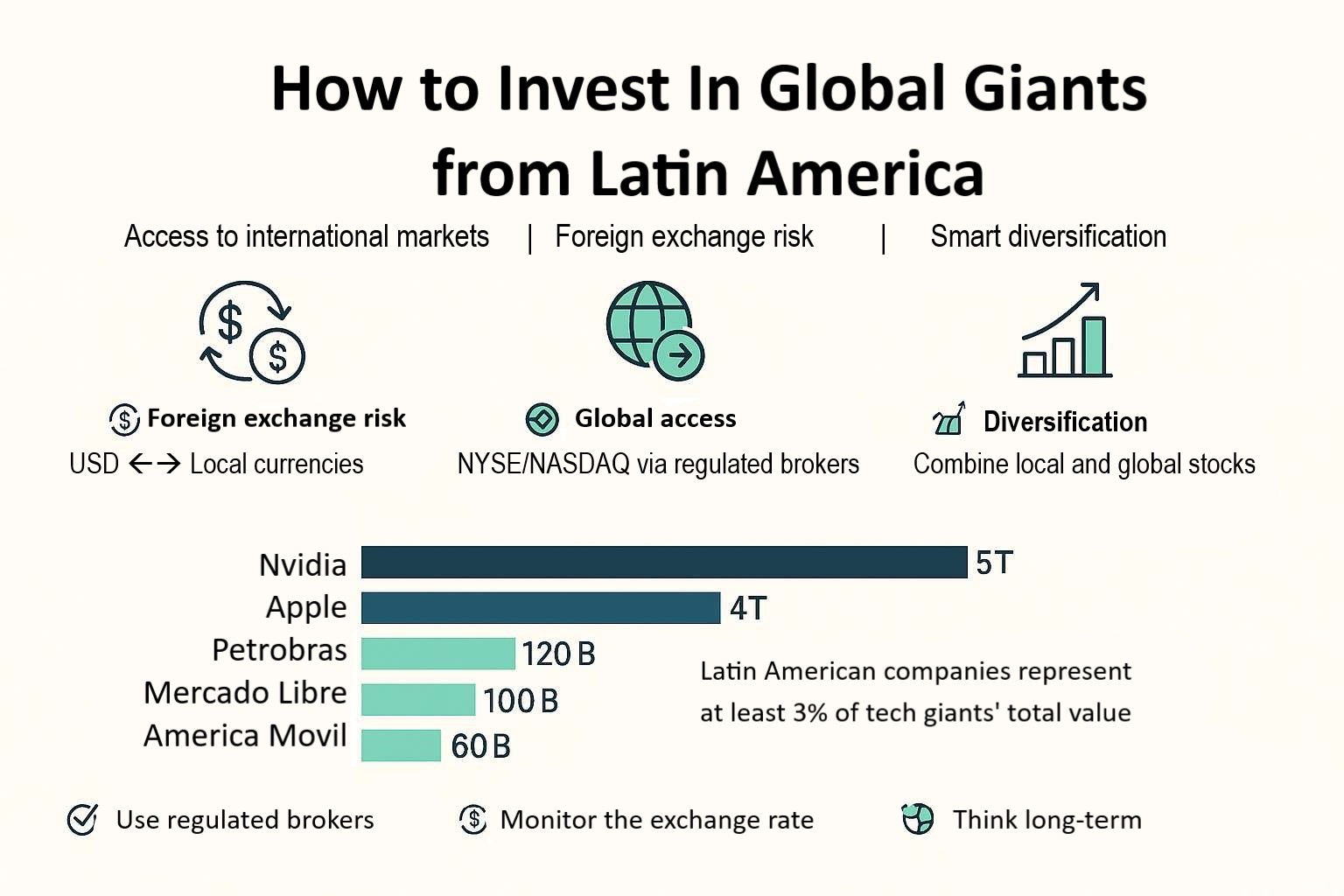
Latin American investors access the NYSE and NASDAQ through regulated international brokers and digital platforms. Dividends from US companies are generally withheld at 30%, though countries with tax treaties, such as Mexico and Chile, may reduce it to 10-15%. Each country has its own tax reporting regulations on capital gains and foreign income.
The exchange rate risk between local currencies (Mexican peso, Brazilian real, Colombian peso, Chilean peso) and the US dollar can significantly impact returns. Currency conversion and international transfer fees should be considered when forming an investment strategy. Platforms such as MetaTrader 4 and MetaTrader 5 offer advanced technical analysis and portfolio-tracking tools that are accessible across Latin America.
Comparison: Latin American companies vs Global Giants
Latin America's leading companies show significant differences in market capitalisation compared to the world's tech giants. Petrobras, Brazil's largest company, has a market capitalisation of approximately $120 billion (as of October 2025), which represents just 2.4% of Nvidia's value. The state-owned oil company leads the Latin American energy sector but faces volatility related to oil prices.
América Móvil, owned by Carlos Slim, maintains a capitalisation of close to $60 billion. This figure is less than 1.5% of Apple's valuation. Vale, the Brazilian mining giant, has a market capitalisation of approximately $55 billion. CEMEX, the Mexican leader in cement and construction materials, has a valuation of close to $15 billion.
Mercado Libre, the "Latin American Amazon", stands out with a capitalisation of more than $100 billion, making it the most valuable technology company in the region. Grupo Bimbo, the world's largest bakery, has a valuation of close to $8 billion. Femsa (operator of Oxxo and Coca-Cola bottler) has a capitalisation of approximately $20 billion.
The major Latin American stock markets are dominated by traditional sectors such as energy, mining, banking and consumer. Companies in the region generate consistent dividend yields. Petrobras has offered extraordinary dividends in periods of high oil prices. For Latin American investors, diversifying between local and international companies provides an optimal balance. CFDs make it possible to trade these companies' stocks without owning them directly.
Ecopetrol (Colombia), Bancolombia, Banco de Chile, Itaú Unibanco (Brazil) and Falabella (Chile) represent other solid options for regional exposure. These corporations demonstrate that Latin American companies can compete internationally, albeit at more affordable valuations than US technology giants.
Warren Buffett and famous companies: Expert validation
Warren Buffett provides fundamental validation through his investment decisions. Through Berkshire Hathaway, he holds a massive stake in Apple valued in the tens of billions, his largest single position.
Buffett's philosophy focuses on companies with sustainable competitive advantages ("moats"). Apple meets these criteria through its closed ecosystem. Buffett also holds significant investments in American Express and Coca-Cola, which have generated extraordinary returns for decades. Berkshire Hathaway's annual reports are a must-read for serious investors.
Future trends: Which companies will dominate the next decade?
The business landscape of the next decade will be defined by emerging sectors and disruptive technologies. Investors who identify these trends early can benefit from significant growth opportunities:
- Artificial intelligence: Companies such as Nvidia, Microsoft and Google are positioned for exponential growth, with extraordinarily high barriers to entry favouring the current leaders in the speciality semiconductor market.
- Renewable energy and sustainability: Companies that demonstrate a genuine commitment to emissions reduction will attract preferential investment, with Tesla leading the way in electric vehicles as traditional manufacturers accelerate their transition.
- Quantum computing: IBM, Google, and Microsoft are investing massively in this disruptive technology that could solve problems currently beyond the reach of classical computers.
- Biotechnology and digital health: Growth driven by population ageing, advances in personalised medicine based on genomics and expansion of telemedicine platforms.
- Advanced e-Commerce: Expansion continues with Amazon maintaining global leadership, while regional competitors emerge and social commerce gains traction on platforms such as Instagram and TikTok.
Investments in green infrastructure could generate significant opportunities. Genomics-based personalised medicine promises to transform disease treatment. Companies that integrate online and offline experiences seamlessly will thrive in the new global commercial landscape.
Conclusion: The most famous companies as a reflection of global economic power
The most famous companies are symbols of economic power, technological innovation and the ability to create organisations that transcend borders. The dominance of Nvidia, Microsoft and Apple reflects the digital transformation that defines our era.
The combined capitalisation of the 10 largest companies exceeds the GDP of most countries. Diversification remains fundamental to any prudent investment strategy. Fundamental analysis of financial statements, competitive advantages and management teams is essential.
The future belongs to companies that combine technological innovation with social responsibility. Continuing financial education is crucial to navigating complex markets. Platforms like Libertex provide tools for investors to participate in global markets.
FAQ
Why is Apple consistently near the top of these rankings?
Apple maintains its leadership thanks to its closed ecosystem of products and services that generates extreme loyalty among users. Constant innovation, superior margins and the world's strongest brand recognition allow the company to maintain premium pricing. Its ability to combine hardware, software and services into an integrated experience is difficult to replicate.
What is the difference between market capitalisation and actual revenue?
Market capitalisation is the total market value of a company (share price × number of shares), while actual revenue is the sales generated in a specific period. Market capitalisation reflects future market expectations, while revenues are objective historical data. A company can have high capitalisation with low revenues if investors expect significant growth.
Are these companies a safe long-term investment?
No investment is entirely free of risk, even for companies that have demonstrated consistent growth for decades. Technological, competitive and regulatory changes can affect them. Diversification across different sectors and geographies is critical to any prudent investment strategy.
How do CEO decisions impact enterprise value?
CEOs significantly influence market perception and stock price through strategic decisions and communication. Examples such as Elon Musk at Tesla or Satya Nadella at Microsoft demonstrate how leadership can transform valuations. Investors value CEOs with a clear vision, the ability to execute, and effective communication.
What role do these companies play in the Latin American economy?
These technology companies have a significant presence in Latin America through regional offices, data centres, development teams, and business operations that employ tens of thousands of professionals in Mexico, Brazil, Colombia, Chile and Argentina. Latin American investors can participate in their growth through international brokers and digital platforms accessible in the region. The digital transformation of Latin American companies relies heavily on the technologies and services developed by these global giants, driving regional innovation and competitiveness.
Should Latin American investors diversify beyond these giants?
Geographic and sector diversification is fundamental to any prudent investment strategy. Latin American investors should consider exposure to leading local companies (Petrobras, Vale, Mercado Libre, América Móvil), developed markets (US, Europe) and other emerging regions (Asia) in addition to technology giants. Latin American companies with good fundamentals offer attractive dividends and exposure to regional growth, while index funds provide automatic diversification at low cost.
Not financial advice. The content of this article is provided by Libertex for general information and educational purposes only. It does not constitute investment advice, investment research, a personal recommendation, or an offer or solicitation to buy or sell any financial instrument or other asset. It is general in nature and is not tailored to any individual reader, so it cannot account for your personal circumstances, financial situation, knowledge, experience, or investment objectives. Any decision to act on this content is taken at your own discretion and risk, and you remain solely responsible for assessing whether a product or strategy is right for you and for seeking independent professional advice where appropriate.
Risk warning. Trading in financial instruments and other assets, particularly leveraged products such as CFDs, is complex and carries a high risk of losing money rapidly. Leverage magnifies both gains and losses, so small market movements can lead to disproportionate losses. The value of the assets referenced may rise or fall, and you may lose your entire invested amount. Past performance is not a reliable indicator of future results. The use of artificial intelligence, algorithms, automated strategies, or any other analytical tool in trading does not guarantee any particular outcome, does not eliminate risk, and does not replace your own judgement — you remain fully responsible for assessing every instrument, strategy, and decision, and for the results of your trading.
Why trade with Libertex?
- Get access to a demo account free of charge
- Receive live technical assistance 5 days a week, 24 hours a day
- Enjoy leverage of up to 1:500
- Use a platform for any device: Libertex and MetaTrader 4 and 5
- Pay zero commission on withdrawals in Latin America
- Benefit from up to $500 protection on your first trades with Negative Trade Protection