

Michael Burry: his investment strategy, portfolio and net worth in 2026
Michael Burry is a US investor and former physician recognised for anticipating the 2008 subprime mortgage crisis while running Scion Capital. This article is an update based on Scion Asset Management's latest disclosed 13F filing, covering his investment philosophy, stock-picking criteria, current portfolio, track record and the market commentary he has issued in 2026, for informational purposes only.
Some of the companies that have appeared in his disclosed filings over time, including Estée Lauder, are also available on the Libertex trading platform through real shares or CFDs; these are different instruments, with different ownership rights and risk profiles, alongside educational materials on reading financial markets.
Key takeaways
- Value plus contrarian: Burry combines classic value investing with a willingness to hold positions the market has abandoned, investing only at a deep discount to calculated intrinsic value.
- Latest 13F: Scion Asset Management's Q3 2025 filing, dated 3 November 2025, discloses eight positions worth about $1.38 billion, led by put options on Palantir Technologies and NVIDIA.
- Signature trade: his subprime mortgage short returned 489% net of fees for Scion Capital between November 2000 and June 2008 – a historical result that is not representative of typical or future performance.
- 2026 commentary: Burry has compared current market conditions to the 1999-2000 dot-com bubble and called markets "fragile", without naming a date for any downturn.
- Net worth: commonly estimated at $300-400 million, though this figure is not publicly disclosed.
Who is Michael Burry?
Michael J. Burry earned his Doctor of Medicine from Vanderbilt University School of Medicine in 1997 and began a neurology residency at Stanford University Medical Center before leaving clinical practice, according to Vanderbilt University Medicine's alumni records. In 2000, he founded Scion Capital, a hedge fund built on Benjamin Graham's value-investing principles. His medical training centred on pattern recognition: reaching a diagnosis from indirect data points rather than obvious symptoms. Burry has described applying a similar process to financial statements, looking past a company's headline narrative for the underlying numbers the broader market has not fully priced in. That evidence-first habit, rather than any formal finance training, is often cited as the origin of his research-heavy approach to stock selection.
Burry’s investment philosophy: value and contrarian investing
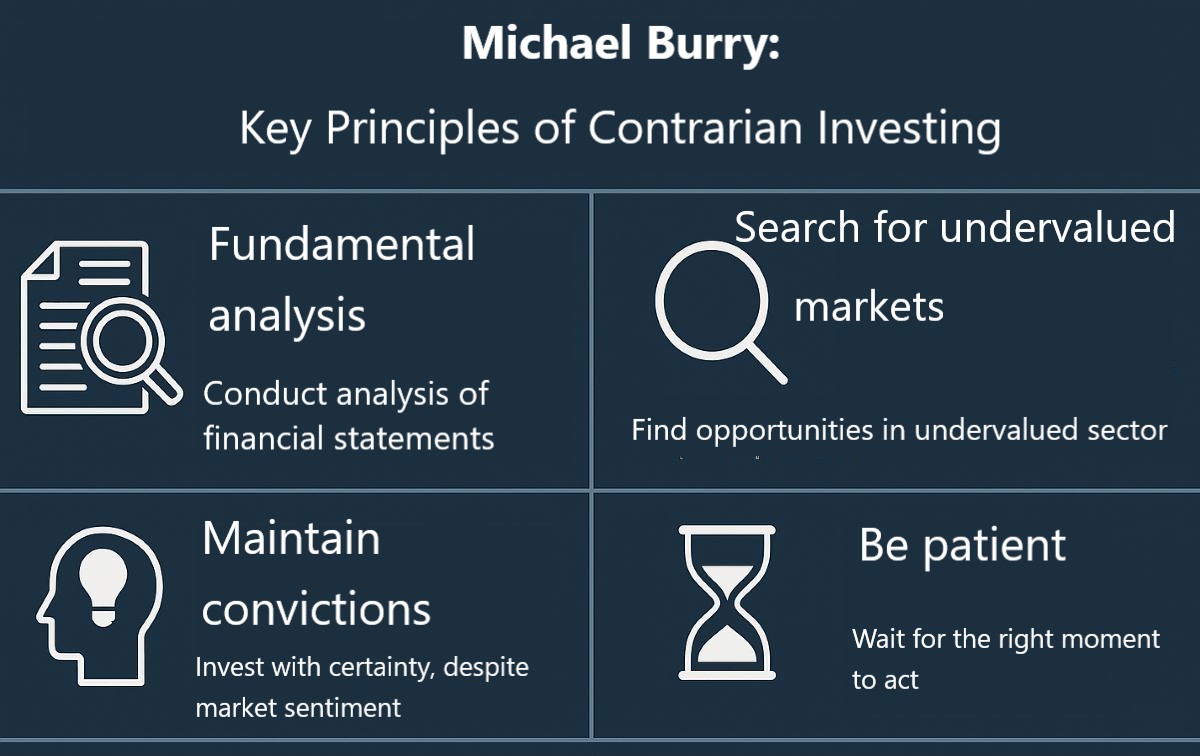
Burry's methodology rests on four connected ideas, documented across his public letters and interviews reported by outlets including Institutional Investor and Business Insider.
- Absolute, not relative, value: Burry judges a company against its own calculated intrinsic worth rather than against sector peers. In a widely cited 2006 letter, he compared Mexican poultry producer Bachoco to its book value rather than to other food-sector multiples, illustrating why a stock can look expensive by relative measures while still trading below its absolute worth.
- Margin of safety: he typically looks for a price 30-40% below his own calculated value, a buffer intended to limit downside if his analysis turns out to be wrong, a concept drawn from Benjamin Graham.
- Bubble diagnosis through credit data: rather than reading price charts, Burry has said he tracks credit-cycle indicators, such as lending standards and leverage levels, as an analytical method for spotting unsustainable conditions rather than a short-term trading signal.
- Downside-first filtering: before considering upside, he estimates the loss a position could produce if the thesis fails; a position that avoids a 30% drawdown compounds very differently over a decade than one that does not.
For readers who want to study price and volume data directly, MetaTrader 5, available on the Libertex platform, and its technical analysis resources provide charting tools; used, as Burry does with credit-cycle data, as one research input rather than a signal to open a position.
Stock-picking criteria: a checklist
Burry's public letters and interviews point to one comparatively narrow checklist rather than several separate strategies. None of these criteria remove the risk of loss, and following them does not guarantee a particular result.
- Trajectory of intrinsic value: he separates businesses into those with a rising per-share value over time, those in steady decline, and those in distress, then concentrates research on the first group.
- Small and micro-cap, global focus: Burry has repeatedly favoured smaller, less-followed companies, including outside the US, on the view that they are more likely to be mispriced by the broader market.
- Balance-sheet, debt and share-count review: he checks debt levels, cash position, and whether the share count is shrinking through buybacks or growing through dilution, preferring businesses that generate cash rather than consume it.
- Special situations: spin-offs, restructurings and other corporate-event-driven mispricings feature repeatedly among his disclosed positions.
Free tools commonly used for this type of screening include SEC EDGAR for primary filings, Macrotrends for historical financial data, and Finviz for quantitative screening; none of them, on their own, replace independent research.
Current portfolio: the latest 13F (Q3 2025)
13F filings disclose only US-listed long equity and options positions as of the previous quarter-end, are published up to 45 days later, and do not show short positions, cash, or non-US holdings, so Scion Asset Management's actual exposure may differ materially from the table below.
| Position | Type | Approx. value / notional |
| Palantir Technologies (PLTR) | Put options | About $912 million |
| NVIDIA (NVDA) | Put options | About $187 million |
| Pfizer (PFE) | Call options | About $153 million |
| Halliburton (HAL) | Call options | About $62 million |
| Molina Healthcare (MOH) | Long shares | Included in total |
| Lululemon Athletica (LULU) | Long shares | Included in total |
| SLM Corporation (SLM) | Long shares | Included in total |
| Bruker Corp preferred (BRKR) | Long preferred shares | Included in total |
| Total (8 positions) | – | About $1.38 billion |
Source: SEC
For historical context, Burry fully exited his long China positions, including Alibaba Group, Baidu and JD.com, in the first quarter of 2025, two quarters before this filing.

Legendary trades and track record
Burry's reputation rests on a small number of large, well-documented trades rather than on consistent long-term returns.
His most closely associated trade was a bet against subprime mortgage securities, built through credit default swaps between 2005 and 2007. Scion Capital returned 489% net of fees from its founding in November 2000 to its closing in June 2008, according to figures widely reported and later detailed in Michael Lewis's "The Big Short"; Burry personally earned an estimated $100 million from the fund, while investors received roughly $725 million.
A separate, frequently misremembered trade involves GameStop. Burry purchased GameStop shares in 2019 as a value and corporate-governance position and sold his stake before the retail-driven short squeeze of January 2021, according to his own 13F filing history, so his original thesis was not part of that event.
In an earlier 2025 filing, Scion disclosed put options on Tesla with a notional value of about $530 million across more than 800,000 shares; the position had been closed or altered by the time of the Q3 2025 filing described above, and its ultimate profit or loss has not been confirmed.
Burry's net worth is commonly estimated at $300-400 million by financial-media wealth trackers; this figure is not publicly disclosed by Burry or Scion Asset Management and should be treated as an estimate rather than a confirmed figure.
Is Burry predicting a crash in 2026?
Burry's 2026 public statements are warnings framed around valuation and credit conditions, not a dated prediction of a market crash.
"The last months of the 1999-2000 bubble"
– Michael Burry, public statement, May 2026
"Fragile"
– Michael Burry, describing broader market conditions, March 2026
These comments follow the same credit-cycle and valuation framework described in his investment philosophy, and align with the put positions on Palantir Technologies and NVIDIA disclosed in his Q3 2025 13F, which imply a bearish view on parts of the artificial-intelligence trade rather than on the market overall.
Burry's public warnings have, in previous cycles, preceded market moves by months or years rather than days or weeks, and none of his statements name a specific date for any downturn; they should be read as one analyst's view among many, not as an instruction to buy or sell.
How to apply Burry's strategy
Retail investors can adapt elements of Burry's process at a smaller scale, while accepting that concentrated, contrarian positions carry greater risk than diversified ones.
- Set a margin-of-safety threshold before screening, rather than after finding an interesting company.
- Screen small and micro-cap companies globally rather than limiting research to well-covered large caps.
- Categorise each candidate by the trajectory of its intrinsic value: rising, flat or declining.
- Check the balance sheet, debt level and share count before looking at the growth story.
- Look for special situations such as spin-offs or restructurings, where mispricing is more common.
- Size each position by its potential downside before considering the potential upside.
- Avoid trading on daily price moves; a thesis-driven approach depends on holding periods measured in quarters or years.
Common mistakes include investing without fully understanding the business, skipping the margin-of-safety calculation, and reacting to short-term price swings rather than to changes in the underlying thesis.

Contracts for Difference (CFDs) are complex instruments and come with a high risk of losing money rapidly due to leverage. Before trading, make sure you fully understand how they work, the risks involved, and whether you can afford to take the high risk of losing some or all of your invested capital; past performance is no guarantee of future results.
Criticisms and limitations
Burry's approach carries risks and drawbacks that are separate from its documented successes.
- Concentration risk: holding a small number of positions magnifies both gains and losses relative to a diversified portfolio.
- Timing risk: being early on a thesis, sometimes by years, can mean sustained losses before, if ever, a position is proven correct.
- Illiquidity: small and micro-cap holdings can be harder to buy or sell at a stable price than large, widely traded stocks.
- Portfolio opacity: a derivatives-heavy 13F, disclosed up to 45 days late and without hedges or short positions, gives an incomplete picture of actual risk.
- Ethical debate: betting against an asset through instruments such as credit default swaps or put options remains a subject of ongoing debate among market participants and commentators.
Conclusion: Michael Burry's key lessons for investors
Michael Burry's record points to a small number of consistent habits rather than a single trade: judging value against a company's own fundamentals, requiring a margin of safety before investing, and sizing positions around downside risk before upside. His 2026 commentary continues that same framework rather than introducing a new one. None of this removes the risk that comes with concentrated, contrarian positions, and his results, like those of any investor, have varied significantly between periods.
FAQ
What is Michael Burry's investment strategy?
Michael Burry combines classic value investing with a contrarian approach, investing in assets the market has abandoned only when they trade at a deep discount to their calculated intrinsic value, and checking capital preservation before upside potential. He develops his conclusions through fundamental analysis of financial statements rather than through price charts or market sentiment.
In which sector does Michael Burry currently invest the most?
He is currently focused on the US consumer and healthcare. His largest positions in Q2 2025 are Estee Lauder (21.55%) and Lululemon Athletica (21.12%), followed by scientific instruments and biotech with Bruker Corp and Regeneron Pharmaceuticals.
What is in Michael Burry's portfolio right now?
The latest publicly disclosed 13F, for the third quarter of 2025 and filed 3 November 2025, shows eight positions worth roughly $1.38 billion, led by put options on Palantir Technologies and NVIDIA and call options on Pfizer and Halliburton, alongside long positions in Molina Healthcare, Lululemon Athletica, SLM Corporation and Bruker preferred shares.
Is Michael Burry predicting a market crash in 2026?
Burry issued public warnings in 2026, including comparing US markets to "the last months of the 1999-2000 bubble" in May and calling the market "fragile" in March, but he has not named a specific date for a downturn, and his warnings have historically preceded market moves by months or years.
Did Michael Burry sell GameStop before the 2021 short squeeze?
Yes. Burry purchased GameStop shares in 2019 as a value and corporate-governance position and sold his stake before the January 2021 retail-driven short squeeze, so his original thesis was not part of that event, based on his own disclosed filing history.
What is Michael Burry's net worth?
Michael Burry's net worth is commonly estimated at around $300-400 million, though this figure is not publicly disclosed by Burry or Scion Asset Management and should be treated as an estimate from secondary sources rather than a confirmed figure. This information is provided for informational purposes only and does not constitute personalised investment advice.
How can an average investor apply Michael Burry's strategy?
Retail investors can adapt Burry's approach at a smaller scale by setting a margin-of-safety threshold before screening, focusing on small and micro-cap companies with sound balance sheets, sizing positions by downside risk first, and avoiding decisions based on daily price moves.
What are the risks or criticisms of Michael Burry's investing approach?
Common criticisms include concentration in a small number of positions, the risk of being early on a thesis for months or years before, if ever, it plays out, the illiquidity of small and micro-cap holdings, and the limited visibility a derivatives-heavy, 45-day-delayed 13F gives into his actual risk exposure.
Not financial advice. The content of this article is provided by Libertex for general information and educational purposes only. It does not constitute investment advice, investment research, a personal recommendation, or an offer or solicitation to buy or sell any financial instrument or other asset. It is general in nature and is not tailored to any individual reader, so it cannot account for your personal circumstances, financial situation, knowledge, experience, or investment objectives. Any decision to act on this content is taken at your own discretion and risk, and you remain solely responsible for assessing whether a product or strategy is right for you and for seeking independent professional advice where appropriate.
Risk warning. Trading in financial instruments and other assets, particularly leveraged products such as CFDs, is complex and carries a high risk of losing money rapidly. Leverage magnifies both gains and losses, so small market movements can lead to disproportionate losses. The value of the assets referenced may rise or fall, and you may lose your entire invested amount. Past performance is not a reliable indicator of future results. The use of artificial intelligence, algorithms, automated strategies, or any other analytical tool in trading does not guarantee any particular outcome, does not eliminate risk, and does not replace your own judgement — you remain fully responsible for assessing every instrument, strategy, and decision, and for the results of your trading.
Why trade with Libertex?
- Get access to a demo account free of charge
- Receive live technical assistance 5 days a week, 24 hours a day
- Enjoy leverage of up to 1:500
- Use a platform for any device: Libertex and MetaTrader 4 and 5
- Pay zero commission on withdrawals in Latin America
- Benefit from up to $500 protection on your first trades with Negative Trade Protection