

How to Invest in Gold: A Complete Guide to Every Method, Cost and Strategy in 2026
Gold has anchored investment portfolios through decades of inflation, currency depreciation, and financial-market stress, and 2026 has been no exception: spot prices moved above $4,000 per ounce for the first time in the metal's history, up more than 20% over the past year. This article covers every major way to invest in gold, from physical bars and coins to ETFs, mining stocks and digital tokens, along with the costs, storage needs and allocation ranges that determine which method suits which investor.
The price move is tracked in real time by data providers such as Trading Economics (July 2026), and investors can follow live gold pricing directly. However, just as with any asset, past price performance is not a guarantee of future results, a point worth keeping in mind throughout the historical comparisons later in this article.
Key takeaways
- Gold plays four distinct portfolio roles: inflation hedge, safe-haven asset, diversifier, and long-horizon retirement holding.
- There are two fundamentally different ways to own gold: physical bullion (direct ownership of metal) and financial instruments such as ETFs, mining stocks or futures (contracts and shares that track gold's price).
- Six practical routes exist within those two categories: bars, coins, vaulted/IIG gold, savings plans, ETFs/mutual funds, and mining stocks, plus more specialised instruments such as futures and digital gold.
- Most research points to a 5–15% portfolio allocation range, with newer World Gold Council data suggesting measurable risk-adjusted benefits starting from as little as 2.5–5%.
- Consistent, long-term allocation and periodic rebalancing have historically outperformed attempts to time entry points around news-driven price spikes.
Why invest in gold? Understanding gold's true role in a portfolio
Gold's place in a portfolio is best understood through four distinct, evidence-backed functions rather than as a single speculative bet. Research from the World Gold Council consistently frames an allocation in the 4–15% range as the point at which gold's inflation-hedging, safe-haven and diversification properties are most likely to improve a portfolio's risk-adjusted return, before the details are examined role by role below.
Gold as an inflation hedge
Gold tends to preserve purchasing power when a currency's value erodes: as fiat money buys less, gold priced in that currency has historically tended to rise. The pattern was clearest during the 1970s stagflation era and again after the 2020–2022 inflation surge. The relationship is not automatic, however. During the early 1980s, sharply rising real interest rates made cash and bonds more attractive and gold underperformed for years, a reminder that gold hedges inflation best over long horizons rather than in every short-term stretch.
Gold as a safe-haven asset during economic uncertainty
During financial crises and geopolitical shocks, investors have repeatedly turned to gold as a form of portfolio insurance, most visibly during the 2008 financial crisis and the 2020 pandemic sell-off. That insurance is not absolute: in the most acute liquidity crunches, investors have sometimes sold gold alongside everything else to raise cash, causing short, sharp dips before gold recovered. Recognising that pattern helps investors hold through short-term volatility rather than treat a temporary decline as a failure of the strategy.
Gold for portfolio diversification
Gold has historically shown low or negative correlation with equities and bonds. In plain terms, it has tended to hold or gain value when other assets fall. World Gold Council analysis of long-run portfolio data shows that allocations in the mid-single digits have historically improved risk-adjusted returns for a balanced stock-and-bond portfolio without materially increasing overall volatility.

Gold for retirement and pension portfolio planning
Gold's long-term store-of-value characteristic aligns naturally with the multi-decade horizon of retirement saving. Two practical routes exist: a Gold IRA, which allows physical gold ownership inside a tax-advantaged retirement structure, and a standard brokerage account holding gold ETFs within an existing retirement plan. Rules governing Gold IRAs vary by jurisdiction and account type, so investors should consult a qualified tax advisor before choosing this route.
How much gold should be held in a portfolio?
A commonly cited range is 5–15% of a portfolio, though the appropriate figure depends heavily on individual circumstances. One frequently referenced institutional benchmark is a 60:20:20 stocks/bonds/gold split recommended by Morgan Stanley's chief investment officer in late 2025 (Advisor Perspectives), a notably higher figure than most retail guidance. More recent World Gold Council data suggests measurable improvements in risk-adjusted returns and drawdown reduction can appear from an allocation as small as 2.5–5%, meaning the 5–15% range should be treated as a starting point for discussion rather than a fixed target.
- Existing exposure to equities and bonds
- Investment time horizon
- Inflation and currency-risk concerns
- Overall risk tolerance
- Accumulation versus distribution phase of the investment lifecycle
Because these factors vary widely between individuals, a financial advisor is best placed to translate them into a specific allocation.
The two main approaches to investing in gold
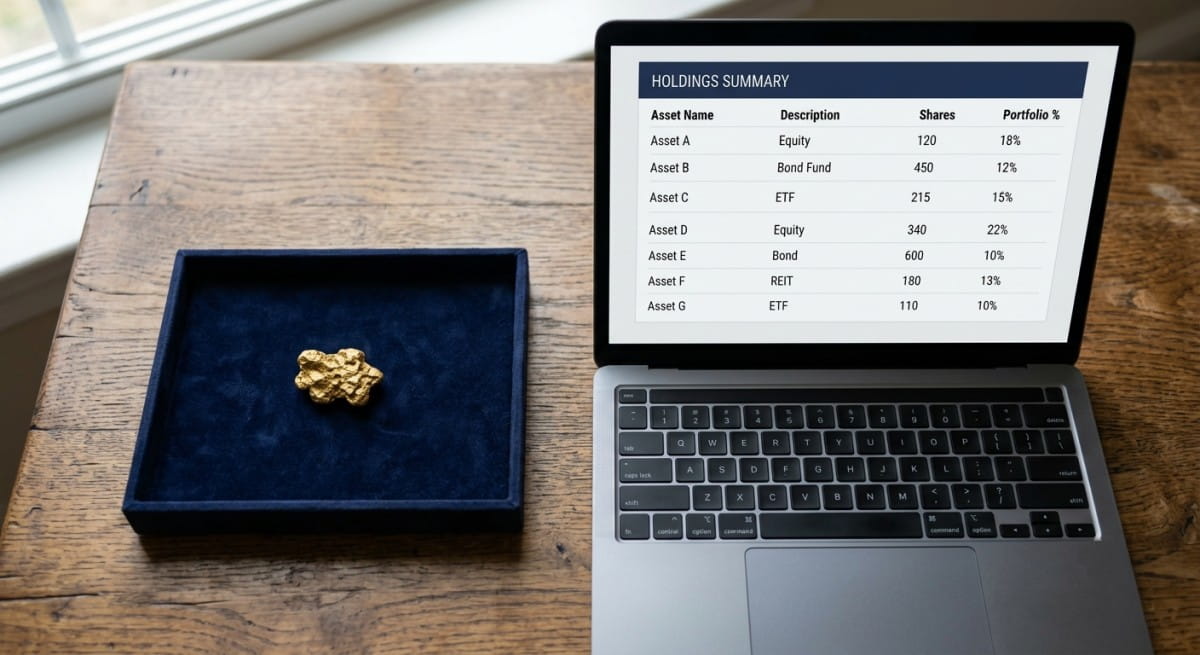
Every method of investing in gold falls into one of two categories, and understanding the difference is the single most important concept for a new gold investor. Physical gold means direct ownership of the metal, such as a bar, coin, or allocated bullion holding. Financial instruments, by contrast, are contracts or shares that track gold's price without conferring direct ownership of metal, such as ETFs, mining stocks, or futures. In other words: owning gold versus tracking gold's price. The distinction rarely matters day to day, but it becomes significant in extreme crisis scenarios, when counterparty and custody structures are tested.
How to invest in physical gold
Physical gold is the most direct form of ownership, but it also introduces practical responsibilities — chiefly storage and insurance — that financial instruments avoid. The five main routes are covered below, followed by a dedicated look at storage.
Gold bars (bullion)
Gold bars range from 1-gram wafers aimed at small investors to the 400-troy-ounce London Good Delivery bar used in professional wholesale markets. As a rule, the smaller the bar, the higher the premium per gram over the spot price, since fabrication and handling costs are spread across less metal. Bars should be bought from LBMA-accredited dealers or established online bullion platforms. Vault storage for bars typically costs between 0.10% and 0.15% of the gold's value per year, a cost worth weighing against the wider retail-to-wholesale price gap covered later in this article.
Gold coins
Investment-grade bullion coins — the American Gold Eagle, Canadian Maple Leaf, South African Krugerrand, and British Britannia among them — should not be confused with numismatic (collectable) coins, which are valued for rarity rather than metal content. Bullion coins are typically 91.67% pure (22-karat) or 99.99% pure (24-karat). Their smaller size makes them easier to divide, widely recognisable, and relatively easy to resell, though coin premiums over spot price are typically higher than those on equivalent-weight bars.
Practical gold storage: home, safe deposit box, and professional vault
- Home storage: the most accessible option, but it requires an insurance-rated safe and formal disclosure to an insurer, and is realistically only suitable for small holdings.
- Safe deposit box: better physical security than home storage, with variable rental costs; contents are not automatically insured by the bank.
- Professional vault storage: the most secure and, for meaningful holdings, most cost-effective option. LBMA-approved facilities typically offer armed response, insurance included in the fee, and independent auditing, for roughly 0.10% to 0.12% of the gold's value per year.
First-time buyers routinely underestimate both the cost and the practical complexity of storing meaningful quantities of gold at home.
Gold jewellery: The least efficient investment method
Gold jewellery carries genuine intrinsic metal value and cultural significance, but retail markups and craftsmanship costs mean buyers typically pay well above melt value, which makes resale at a fair price difficult. High-purity jewellery in some markets — 24-karat pieces common in parts of Asia, for instance — holds investment value more effectively than Western fashion jewellery, where design cost dominates the price. For pure investment purposes, bars or coins remain the more efficient choice.
Vaulted gold and Internet Investment Gold (IIG)
Vaulted gold platforms allow investors to buy outright ownership of physically allocated bullion held in a professional, LBMA-approved vault, with the option to request physical delivery. Because purchases draw on wholesale pricing with far tighter spreads than retail bars or coins, this route is often the most cost-efficient way to hold true physical metal without managing storage personally. Such platforms, including bullion-specific providers among them, commonly allow purchases from as little as one gram. The key distinction to understand is between allocated gold, where an investor owns specific, identifiable bars outright, and unallocated gold, which represents a creditor relationship with the provider rather than direct ownership, carrying counterparty risk that allocated gold does not.
- Is the gold physically allocated and held in the investor's own name?
- Is there an independent audit process?
- What are the annual storage and insurance fees?
- Can physical delivery be requested, and under what conditions?
- Where exactly are the vaults located, and under which jurisdiction?
Gold savings plans: Building gold holdings gradually
Regular gold savings plans let investors build a position through fixed, periodic purchases rather than a single lump sum, a form of cost averaging: a fixed payment buys more gold when prices are lower and less when prices are higher, smoothing the average entry cost over time. This approach suits investors accumulating gradually rather than deploying capital all at once, and is generally available through specialist bullion platforms rather than mainstream retail brokerages, often bundled with professional storage.
How to invest in gold through financial instruments
Financial instruments have made gold broadly accessible to everyday investors, but the trade-off should be understood upfront: owning a gold ETF means owning a financial instrument, not physical gold. That distinction is immaterial in almost all circumstances, but it becomes significant in extreme crisis scenarios, echoing the physical-versus-financial framing introduced earlier in this article.
Gold ETFs and mutual funds
Gold exchange-traded funds are shares that track the spot price of gold, offering high liquidity and, for physically-backed products, annual expense ratios that typically range from roughly 0.10% to 0.40% (for example, SPDR Gold Shares (GLD) at around 0.40% and iShares Gold Trust (IAU) at around 0.25%, as of July 2026, per each fund's own published fee data). Physically-backed ETFs should be distinguished from gold mining ETFs and mutual funds, such as the VanEck Gold Miners ETF (GDX), which hold mining company shares rather than metal. With a physically-backed ETF, the trust owns the underlying gold; the investor owns shares in the trust, and annual fees gradually reduce the effective gold backing per share over time. Brokerage accounts, including those offered by firms such as Fidelity Investments, provide access to these products, making ETFs a practical starting point for many new gold investors.
Gold mining stocks: Indirect exposure with equity risk
Mining stocks carry a leverage-like dynamic. A 10% rise in the gold price can translate into a 20–30% gain for a well-run miner, and the reverse applies just as readily on the way down. That leverage comes from risk layers beyond the gold price itself, such as operational execution, management quality, the geopolitical risk of mine locations, hedging programmes that can cap upside, and rising energy and labour costs. Diversifying across several mining companies, or using a mining-sector ETF such as GDX or GDXJ, spreads some of that company-specific risk. Mining stocks are not a substitute for gold itself: they behave far more like equities than like a commodity holding.
Gold futures, options and forwards: For sophisticated investors only
Futures are standardised contracts to buy or sell a set quantity of gold at a fixed price on a future date, traded on regulated exchanges such as COMEX. Forwards are similar but non-standardised, bilateral agreements used mainly by institutions. Options grant the right, but not the obligation, to buy or sell gold at a set price. These instruments serve legitimate purposes — leverage and large-position management among institutions — but carry real risks, including amplified losses, margin calls, and structural complexity. For the large majority of individual portfolio investors, simpler and more suitable alternatives exist elsewhere in this article.
Gold certificates and digital gold
Gold certificates are documents representing ownership of vaulted physical gold, used mainly by high-net-worth investors, and come in pooled or allocated structures with materially different risk profiles. Digital or tokenised gold takes this further onto a blockchain, with tokens such as Tether Gold (XAUT) or PAX Gold (PAXG) backed by physical metal. Proving true legal ownership of the underlying physical gold in a crisis scenario is generally more complex for tokenised gold than for allocated physical bullion or a well-structured, physically-backed ETF, and the regulatory and custodial framework around digital gold is still developing, a segment worth approaching with a degree of caution.
Comparing gold investment methods: Which is right for you?
The table below brings together every method covered in this article across the attributes that matter most when choosing between them. A beginner with under $5,000 to invest will typically start with a physically-backed ETF or a small vaulted-gold position. An investor building gradually may prefer a savings plan. A retirement saver will lean toward a Gold IRA or ETFs held in an existing retirement account. Someone prioritising direct ownership at the lowest possible cost will look at wholesale vaulted bullion. Meanwhile, an active trader seeking leveraged, short-term exposure is the only profile for whom futures or mining stocks are a primary rather than supplementary tool.
| Method | Physical ownership | Typical minimum | Liquidity | Storage required | Typical annual cost | Best for |
|---|---|---|---|---|---|---|
| Gold bars | Yes | ~$50 | Medium | Yes | 0.10–0.15% (vaulted) | Direct ownership, larger holdings |
| Gold coins | Yes | ~$50 | High | Yes | Storage + premium | Small, divisible holdings |
| Vaulted / IIG gold | Yes | From ~1g | High | Provider-held | 0.10–0.12% | Lowest-cost direct ownership |
| Gold savings plans | Yes (accrued) | Low, recurring | Medium | Provider-held | Provider fee | Gradual accumulation |
| Gold ETFs | No (fund-held) | Cost of 1 share | Very high | No | 0.10–0.40% | Most new investors |
| Gold mutual funds | No | Varies | High | No | Varies (often >0.40%) | Managed exposure |
| Mining stocks | No | Cost of 1 share | Very high | No | Brokerage fees | Leveraged equity exposure |
| Futures/forwards | No | High (margin) | High (futures) | No | Margin + fees | Sophisticated/institutional investors |
| Gold certificates | Depends (pooled/allocated) | High | Low–medium | Provider-held | Provider fee | High-net-worth investors |
| Digital / tokenised gold | Indirect (token claim) | Low | Medium | Provider-held | Platform fee | Digitally-native investors, with caution |
| Gold jewellery | Yes | Varies | Low | Yes | N/A (embedded in price) | Cultural value, not pure investment |
Retail vs wholesale gold: Understanding the cost gap
Retail gold products, i.e., coins and small bars, typically carry buy-sell spreads of 3–8%, while wholesale-priced gold available through vaulted platforms, built around Good Delivery bars, trades at spreads of only a few tenths of a per cent. The gap is easy to underestimate until it is put in numbers: a 1-ounce coin bought at 5% above spot and sold at 2% below spot needs roughly a 7% rise in the gold price just to break even, while a wholesale bar with a round-trip spread of about 0.2% needs almost none. Over a long holding period, that difference compounds into a meaningful gap in realised return.
Silver as an alternative precious metal investment
Silver shares gold's precious-metal status but has a distinct profile: meaningful industrial demand from electronics and photovoltaic (solar) manufacturing, a lower per-ounce cost, and materially higher price volatility. Gold tends to function as the more conservative, wealth-preservation-oriented holding, while silver behaves as a higher-risk, higher-reward complement rather than a replacement within a precious-metals allocation. Some bullion platforms allow both metals to be held under a single account, which lowers the friction of adding a silver position alongside gold.
When is the right time to invest in gold?
Attempting to time gold's price precisely, entry to exit, has historically been a losing approach for most individual investors. A dollar-cost-averaging approach — investing a fixed amount at regular intervals regardless of price — removes the pressure of guessing the exact bottom and has a real psychological benefit: it takes the emotion out of each individual purchase. Counterintuitively, the best time to start building a gold position is often when gold is least in the news, before a fear-driven news cycle pushes prices to a premium. Investors who prefer a more active approach can watch a handful of macroeconomic signals rather than the price alone.
- CPI/inflation readings running above the roughly 2% target most central banks aim for
- Negative or sharply declining real interest rates
- A weakening US dollar against major currencies
- Elevated geopolitical risk or financial-system stress
- Stock-market valuations that look stretched relative to history
For most investors, however, setting a target allocation and rebalancing on a fixed schedule — annually, for example — remains the more reliable long-term approach than reacting to any single signal above.
What factors drive gold investment prices?
Five factors do most of the work in explaining gold price movements, from the largest single driver to the more structural, long-run ones.
- Investment demand: From ETFs, central banks, and private investors, typically the single largest driver of price moves.
- Inflation and real interest rates: Gold tends to perform best when real rates are negative or low, since holding non-yielding gold costs less in opportunity terms.
- US dollar strength: Gold moves inversely to the dollar in most periods, since a weaker dollar makes dollar-priced gold cheaper for holders of other currencies, a dynamic that also shows up in currency pairs such as EUR/USD, which analysts often track alongside gold for exactly this reason.
- Economic uncertainty and geopolitical risk: These drive safe-haven demand spikes during crises.
- Jewellery and industrial demand: Concentrated in Asian markets, provides a structural floor under the price.
One counterintuitive pattern worth remembering: gold price peaks have often coincided with rock-bottom economic sentiment, which can tempt investors into buying only after a crisis has already pushed prices to a premium.
Who invests in gold? Understanding the full investor universe
The range of gold investors is unusually broad: individuals building a position through monthly savings plans sit alongside institutional asset managers, sovereign wealth funds, jewellery manufacturers, and central banks holding gold as a strategic reserve asset. Data from bullion-trading platforms shows retail participation spans a wide range of income levels, while central banks — the institutions that create fiat currency in the first place — continue to buy and hold significant gold reserves, a detail that speaks directly to gold's enduring role as a reserve asset across very different types of investor.
Key risks of investing in gold (and how to manage them)
Gold's strategic case does not remove its risks, and a balanced view is worth stating plainly before summarising them. As with any asset, past performance is not a guarantee of future results.
- Price volatility: Mitigate with a long-term horizon and by avoiding frequent, reactive trading.
- No income generated: Gold pays no dividend or interest; size the allocation accordingly, treating gold as a form of insurance rather than a growth engine.
- Storage and insurance costs: Compare providers, and consider vaulted gold for better cost efficiency at scale.
- Counterparty risk: Prefer allocated physical ownership, or physically-backed ETFs from established, reputable providers, over unallocated or pooled structures.
- Underperformance in strong equity bull markets: Rebalance the allocation periodically and avoid over-concentration in any single asset class.
Conclusion: A clear path to gold investment

Gold functions best as a strategic, time-tested portfolio tool applied for specific reasons — inflation protection, diversification, a safe haven, or a long-horizon retirement holding — rather than as a speculative, fear-driven trade. The decision framework covered in this article comes down to four steps: identify the investment rationale, determine the allocation, select the appropriate method from physical or financial routes, and invest with patience, rebalancing periodically rather than reacting to short-term price moves. Common next steps investors consider at this stage include opening a brokerage account for ETF access, contacting a reputable bullion dealer for physical gold, or consulting a financial advisor to confirm an allocation that fits their own portfolio and risk tolerance.
FAQ
How can a beginner invest in gold?
The most accessible starting point for most beginners is a physically-backed gold ETF bought through an existing brokerage account, since it requires no storage decision and can be purchased for the cost of a single share. Investors who prefer direct ownership from the start can consider a small allocation to gold coins or a low-minimum vaulted-gold platform instead.
What's the best way to invest in gold right now?
There is no single "best" method independent of the investor's goals: physically-backed ETFs offer the simplest, most liquid access for most people, while wholesale vaulted bullion offers the lowest-cost route to direct physical ownership. The comparison table above is designed to match specific investor priorities — cost, liquidity or direct ownership — to the appropriate method.
Should you invest in gold?
That depends on portfolio goals rather than a universal answer. Research from the World Gold Council and others points to a 5–15% allocation historically improving risk-adjusted returns for many balanced portfolios, but the right figure for any individual depends on existing exposure, time horizon, and risk tolerance, and is best confirmed with a financial advisor.
What are the downsides of investing in gold?
Gold generates no income, carries storage and insurance costs for physical holdings, can underperform during strong equity bull markets, and, for unallocated or pooled structures, carries counterparty risk. None of these is a reason to avoid gold outright, but they are reasons to size an allocation deliberately rather than treat gold as a stand-alone strategy.
How do you buy gold?
Gold can be bought as physical bars or coins from LBMA-accredited dealers or established bullion platforms, as vaulted/allocated bullion through specialist online platforms, or as a financial instrument — an ETF, mining stock, or futures contract — through a standard brokerage account offering access to gold markets. The right channel depends on whether the goal is direct physical ownership or simple, liquid price exposure.
Not financial advice. The content of this article is provided by Libertex for general information and educational purposes only. It does not constitute investment advice, investment research, a personal recommendation, or an offer or solicitation to buy or sell any financial instrument or other asset. It is general in nature and is not tailored to any individual reader, so it cannot account for your personal circumstances, financial situation, knowledge, experience, or investment objectives. Any decision to act on this content is taken at your own discretion and risk, and you remain solely responsible for assessing whether a product or strategy is right for you and for seeking independent professional advice where appropriate.
Risk warning. Trading in financial instruments and other assets, particularly leveraged products such as CFDs, is complex and carries a high risk of losing money rapidly. Leverage magnifies both gains and losses, so small market movements can lead to disproportionate losses. The value of the assets referenced may rise or fall, and you may lose your entire invested amount. Past performance is not a reliable indicator of future results. The use of artificial intelligence, algorithms, automated strategies, or any other analytical tool in trading does not guarantee any particular outcome, does not eliminate risk, and does not replace your own judgement — you remain fully responsible for assessing every instrument, strategy, and decision, and for the results of your trading.
Why trade with Libertex?
- Get access to a demo account free of charge
- Receive live technical assistance 5 days a week, 24 hours a day
- Enjoy leverage of up to 1:500
- Use a platform for any device: Libertex and MetaTrader 4 and 5
- Pay zero commission on withdrawals in Latin America
- Benefit from up to $500 protection on your first trades with Negative Trade Protection