

How to Buy Apple Stock (AAPL): A Complete Step-by-Step Guide
Apple Inc. (NASDAQ: AAPL) is one of the most widely held stocks in the world. With a market capitalisation of $4.47 trillion as of June 2026, it consistently ranks among the largest publicly traded companies in history. This guide explains how to buy Apple shares step by step, from selecting a regulated brokerage and placing a first order to conducting fundamental research and managing a long-term position.
Investors looking to access AAPL through a user-friendly, award-winning Stock and CFD Broker can register with Libertex, which has been operating since 2012 and accepts clients from the EEA and Switzerland.
The information in this article is provided for educational and informational purposes only and does not constitute investment advice or a personal recommendation. Trading in financial instruments involves risk.
Key Takeaways
- Apple Inc. (AAPL) trades on the NASDAQ exchange. As of June 2026, its market capitalisation stands at $4.47 trillion.
- Investors can buy whole shares or fractional shares of AAPL. Fractional investing enables entry from as little as $1 through platforms that support it.
- Purchasing AAPL requires a regulated brokerage account. SIPC protection covers up to $500,000 in securities per customer in the event of brokerage failure.
- Apple pays a quarterly dividend. As of 2026, the dividend yield stands at 0.5%.
- Apple's trailing P/E ratio stands at 37.16x as of June 2026, above the broader technology sector average of 28x.
- T+1 settlement means purchased shares transfer to the investor's account within one business day of trade execution.
Why Apple Stock (AAPL) Deserves Consideration
Before examining the mechanics of purchasing AAPL, it is useful to understand what drives the investment case for Apple Inc. and what risks are associated with it.
Apple's Business Model at a Glance
Apple Inc. generates revenue across two primary categories: hardware products and a growing services segment. Founded in April 1976 by Steve Jobs, Steve Wozniak, and Ronald Wayne, the company has evolved from a personal computer manufacturer into one of the world's most vertically integrated technology businesses.
Products: Hardware lines that account for the majority of total revenue:
- iPhone: The dominant revenue driver, accounting for 52% of total net sales as of fiscal year 2025
- Mac: Personal computers
- iPad: Multi-purpose tablets
- Apple Watch and AirPods: Wearables and accessories
Services: The fastest-growing segment by revenue, now the second-largest division:
- iCloud: Cloud storage
- App Store: Digital marketplace
- Apple Pay: Payment processing
- Apple TV+: Subscription streaming
- AppleCare: Extended support plans
- Apple Music: Subscription audio
Apple operates across five geographical segments: Americas, Europe, Greater China, Japan, and Rest of Asia Pacific. The depth of integration across its hardware, software, and services creates an ecosystem lock-in that functions as a durable competitive advantage. Customers who own multiple Apple devices face meaningful switching costs.
Risks to Consider Before Investing in Apple
Informed investors assess downside before committing capital. The following risk factors are specific to Apple Inc. and AAPL as of 2026:
- Market volatility. As a large-cap equity, AAPL is subject to broader market cycles and sentiment shifts.
- iPhone revenue concentration. With approximately half of net sales tied to a single product line, any structural decline in iPhone demand carries material consequences for earnings.
- Greater China exposure. Apple's Greater China segment is a meaningful contributor to revenue. Investors with AAPL exposure should monitor this segment's performance as a proxy for geopolitical sensitivity.
- Regulatory scrutiny. Apple faces ongoing antitrust investigations in the European Union and the United States, particularly regarding App Store practices and platform competition rules.
- AI competitive uncertainty. Apple's strategy in artificial intelligence — including the positioning of Siri relative to competing large language model products — remains an area of active evaluation by analysts in 2026.
- Supply chain cost pressures. In June 2026, Apple CEO Tim Cook announced plans to raise device prices to offset surging chip costs, which may affect hardware demand and margins.
Risk awareness is a component of disciplined investing, not a deterrent. Each risk factor above is an input to position sizing and monitoring cadence, not a reason to exclude AAPL from consideration.
What to Prepare Before Buying Apple Stock
Before placing an order, investors benefit from clarifying their objectives, understanding their risk tolerance, and selecting the appropriate share structure for their capital level.
Whole Shares vs Fractional Shares
Fractional shares enable investors to purchase a portion of one AAPL share for as little as $1. Rather than requiring the full share price, platforms that support fractional investing allow a specified dollar amount to determine the allocation. At the current price of $297.01 per share (as of 22 June 2026), a $30 investment acquires 0.10 shares, with proportional dividend entitlement.
Fractional shareholders receive dividends proportional to their ownership stake. Whole shares carry full voting rights per share and may be preferable for investors with sufficient capital who wish to participate in shareholder votes.
As of 2026, platforms including Revolut and Robinhood support fractional AAPL investing. Availability varies by jurisdiction and platform; investors should verify this feature before opening an account.
How to Choose the Right Brokerage to Buy Apple Stock
Selecting a brokerage is one of the most consequential early decisions an investor makes. The platform determines the fee structure, available order types, research quality, and regulatory protections in place.
Key Features to Compare When Evaluating a Platform
The following criteria are relevant when comparing brokerage options for AAPL:
- Commissions. Many platforms advertise "zero commission" trading. This does not mean zero costs. Payment for order flow, SEC and FINRA regulatory fees, and currency conversion charges may apply. Verify the total cost structure before committing.
- Account minimums. Some platforms require a minimum deposit to begin investing; others allow opening with zero balance and funding before the first trade.
- Fractional share availability. Essential for investors starting with smaller capital amounts.
- Research tools. Access to earnings reports, analyst ratings, price history, and financial statement data directly within the platform supports more informed decision-making.
- Regulatory status. Platforms regulated by recognised authorities — including FINRA in the United States — are subject to conduct standards and investor protection frameworks.
- Order types available. The ability to place market orders, limit orders, and recurring purchases supports a range of investing strategies.
| Platform Type | Commission | Fractional Shares | Research Tools | Best For |
| Fintech App | Often zero (check fees) | Usually yes | Basic | Beginners, low capital |
| Discount Broker | Low to zero | Often yes | Intermediate | Self-directed investors |
| Full-Service Broker | Higher | Varies | Advanced | High-value portfolios |
How Investor Assets Are Protected
Securities Investor Protection Corporation (SIPC) coverage applies to accounts held at SIPC-member brokerage firms in the United States. In the event of brokerage failure — not market losses — SIPC covers up to $500,000 in securities per customer, including up to $250,000 in cash. This protection does not insulate investors from declines in the value of their holdings.
The Financial Industry Regulatory Authority (FINRA) oversees broker-dealer conduct in the United States, establishing standards for how firms interact with clients and manage customer assets. Shares purchased through a regulated platform are held in the investor's name, not the firm's.
Step-by-Step: How to Buy Apple Stock (AAPL)
The following steps convert preparation into action. Each step covers one discrete stage of the purchase process.
Step 1: Open and Fund a Brokerage Account
To purchase AAPL, investors must first open a brokerage account. The process typically requires a government-issued ID and basic personal and financial information, and can be completed online in 5 to 15 minutes.
Accounts can be funded via bank transfer, debit card, or wire. Some platforms permit browsing available securities before the account is funded. Choosing a platform regulated by a recognised authority — such as a FINRA-member firm — and covered under SIPC ensures a baseline of investor protection.
Step 2: Search for Apple Stock Using Ticker Symbol AAPL
Apple Inc. is listed on the NASDAQ exchange under the ticker symbol AAPL. When searching within a brokerage platform, using the ticker symbol rather than the company name avoids confusion with similarly named securities.
Some platforms display prices with a 15-minute delay rather than in real time. Investors should verify whether the price shown is live before acting on it, particularly if placing a market order.
Step 3: Decide on Share Quantity or Dollar Amount
Modern brokerage platforms typically allow investors to specify either the number of shares to purchase or the total dollar amount to invest. The dollar-amount method is especially practical for fractional investing, where the platform calculates the equivalent share fraction automatically.
Position sizing — the proportion of total portfolio value allocated to a single holding — is a risk management consideration. Concentrating a disproportionate share of capital in a single equity, even a high-quality one, increases the impact of company-specific risk on the overall portfolio.
Step 4: Choose an Order Type
The order type determines when and at what price the trade executes. Three order types are commonly available for AAPL:
- Market Order: Executes immediately at the best available current price. Appropriate for most long-term investors purchasing a highly liquid large-cap such as AAPL during regular NASDAQ trading hours (9:30 AM–4:00 PM ET).
- Limit Order: Executes only if AAPL reaches a specified price or better. Useful during periods of elevated volatility or when price precision is a priority.
- Market-on-Open Order: Executes at the opening price of the NASDAQ trading session. Suitable for investors who wish to participate in the day's opening price.
For most long-term investors in AAPL, a market order placed during regular trading hours is a practical and straightforward choice.
Step 5: Review, Submit, and Track Your Order
Before confirming a purchase, review the order summary: verify the ticker (AAPL), the quantity or dollar amount, the order type, and the estimated total. Submitting an order with incorrect parameters may be difficult to reverse.
Under T+1 settlement rules, shares transfer to the investor's account within one business day of execution. Pending orders are typically visible under an "Orders" tab; completed transactions appear under "Transactions" or equivalent. Unexecuted limit orders can generally be cancelled before execution.
Many platforms support recurring buy orders, which execute automatically at a specified interval. This enables dollar-cost averaging, i.e., purchasing a fixed dollar amount at regular intervals regardless of the prevailing price, which smooths the average cost per share over time.
How to Research Apple Stock as an Informed Investor
Research separates conviction-based investing from speculative behaviour. Fundamental analysis of a company's financial health, valuation, and earnings trends provides the analytical foundation for evaluating AAPL as a long-term holding.

Fundamental Analysis: Core Metrics for Evaluating AAPL
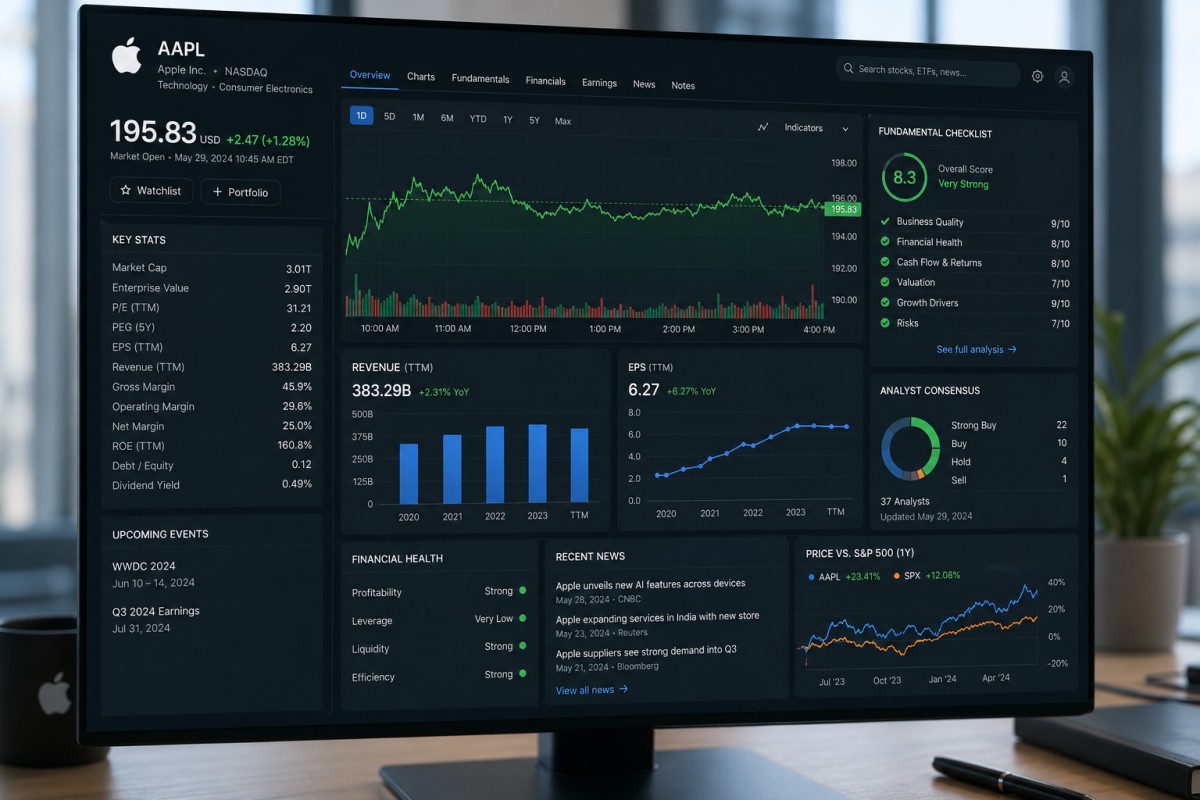
The following metrics are standard inputs for evaluating Apple Inc.'s financial position. All figures reflect data available as of June 2026.
| Metric | Value | Note |
| Ticker / Exchange | AAPL / NASDAQ | Listed since December 1980 |
| Current Price | $297.01 | 22 June 2026 |
| Market Cap | $4.47 trillion | June 2026 |
| 52-Week High | $317.40 | 8 June 2026 |
| 52-Week Low | $195.07 | 18 June 2025 |
| Trailing P/E | 37.16x | vs tech sector average 28x |
Source: Morningstar, Yahoo Finance
Key metrics and their relevance for AAPL analysis:
- P/E Ratio (Price-to-Earnings). Divides the current share price by earnings per share. Apple's trailing P/E of 37.16x as of June 2026 sits above the broader technology sector average, indicating a valuation premium. Investors should contextualise this against Apple's growth trajectory and Services segment margin expansion.
- EPS (Earnings Per Share). Year-over-year EPS growth serves as a forward momentum signal. Apple reported 12.8% revenue growth in Q2 2026. Quarterly and annual earnings releases are primary reassessment opportunities.
- Revenue Growth. The Services segment is the primary incremental driver. Hardware revenue remains subject to product cycle cadence.
- Gross Profit Margin. Apple's Services margin is materially higher than its hardware margin, making the Services revenue mix a key factor in overall profitability.
- ROE (Return on Equity). Calculated by dividing net income by shareholder equity. A higher ROE indicates more efficient use of capital.
- PEG Ratio (Price/Earnings-to-Growth). Adjusts the P/E ratio by the expected earnings growth rate, providing a more nuanced view of relative valuation.
- EBITDA. Earnings before interest, taxes, depreciation, and amortisation, a measure of core operating power that facilitates comparison across capital structures.
Analyst Views on AAPL
Analyst consensus on Apple as of June 2026 reflects a generally constructive view, with near-term attention focused on the company's AI integration roadmap and device pricing response to component cost inflation.
Bank of America
Bank of America analysts have noted that they already expected Apple to raise pricing to offset memory cost increases, citing the company's demonstrated pricing power and supply chain resilience as ongoing strengths. The bank maintains a Buy rating on AAPL.
Jefferies
Jefferies analysts have reiterated a Buy rating on AAPL, maintaining a $380 price target. Their view emphasises Apple's pricing power and supply chain strength as key attributes supporting the investment case.
Reading Financial Statements and Earnings Reports
Apple publishes quarterly and annual financial reports through its Investor Relations page at Investor Apple. Four line items provide the most direct read on business health:
- Total Revenue: Aggregate sales across all product and service categories and geographies.
- Gross Profit: Revenue minus cost of goods sold; reflects the efficiency of Apple's production and service delivery.
- Net Income: The bottom-line result after all expenses, taxes, and interest. Apple's quarterly dividends are funded through net income and operating cash flow.
- Operating Cash Flow: The most instructive indicator of genuine business health, as it reflects actual cash generated by operations rather than accounting income.
Earnings reports also include revenue by segment (Products vs Services) and by geography. The Greater China segment warrants specific attention as a proxy for geopolitical and regulatory risk. EPS results are reported against analyst consensus estimates. A miss or beat relative to expectations typically influences short-term price movement.
What to Do After Buying Apple Stock
The investment process does not conclude at execution. Post-purchase discipline — monitoring, rebalancing, and tax planning — is a distinguishing characteristic of long-term investors.
How to Monitor and Manage Your Apple Investment
A structured monitoring cadence prevents reactive decisions driven by short-term price noise. The following practices are relevant for AAPL holders:
- Price alerts. Setting alerts at ±10% from the original purchase price prompts a structured reassessment of the investment thesis rather than an emotional response.
- Earnings calendar. Apple reports quarterly results four times per year. Each release is a natural opportunity to review whether the fundamental case remains intact.
- Principled sell criteria. A disciplined framework for exiting a position centres on thesis changes — such as a structural deterioration in Services growth, a governance concern, or a material regulatory change — rather than price movement alone. Tax-loss harvesting, portfolio rebalancing, and panic selling represent distinct decision types and should not be conflated.
- Dollar-cost averaging. Recurring buy orders enable automatic position building at regular intervals, smoothing entry price across market cycles.
Apple's quarterly dividend is confirmed each quarter. Monitoring dividend payment confirmation is a routine component of AAPL ownership.
Tax Considerations When Holding Apple Stock
The following tax principles apply to AAPL holdings. Tax treatment varies by jurisdiction; the below reflects general principles applicable to many investors and is not jurisdiction-specific advice.
- Short-term capital gains. Shares sold within 12 months of purchase are typically subject to tax at the investor's ordinary income rate in many jurisdictions.
- Long-term capital gains. Shares held for 12 months or longer may qualify for a reduced capital gains rate, depending on the investor's jurisdiction.
- Dividend taxation. Apple pays quarterly dividends. These constitute taxable income in the year received, regardless of whether the shares are held or sold.
Investors should consult a qualified tax professional for jurisdiction-specific guidance on capital gains treatment and dividend income classification.
FAQ
How and where can I buy Apple stock?
Apple stock (AAPL) can be purchased through any regulated brokerage account that provides access to the NASDAQ exchange, where AAPL is listed. Investors search for the ticker symbol AAPL on their chosen platform, select the desired quantity or dollar amount, choose an order type, and confirm the purchase. The shares are credited to the account within one business day under T+1 settlement rules.
What is the minimum amount required to buy Apple Inc. stock (AAPL)?
There is no regulatory minimum for purchasing AAPL. The effective minimum depends on the platform. Through brokerages that support fractional share investing, AAPL can be purchased for as little as $1, with the platform allocating the proportional fraction of a share. Platforms that support only whole-share purchases require the full share price at the time of transaction, $297.01 as of 22 June 2026.
How do I select a brokerage platform to buy Apple stock?
Key criteria when selecting a brokerage for AAPL include: commission structure (including hidden costs such as payment for order flow), fractional share availability, research and charting tools, account minimums, and regulatory status. Platforms regulated by recognised authorities and covered under SIPC offer investor protection of up to $500,000 in securities per customer in the event of firm failure.
Can I buy fractional shares of Apple stock?
Yes. Many brokerage platforms support fractional share investing in AAPL, enabling investment from as little as $1. Fractional shareholders receive dividends proportional to their ownership stake and benefit from the same price appreciation as whole-shareholders. Availability depends on the platform and jurisdiction.
What are the risks of investing in Apple stock?
Key risks associated with AAPL include market volatility, concentration of revenue in the iPhone product line, geopolitical exposure through the Greater China segment, ongoing regulatory scrutiny in major markets, and uncertainty regarding Apple's competitive positioning in artificial intelligence. Diversification across asset classes and sectors is one approach to managing company-specific risk within a broader portfolio.
Not financial advice. The content of this article is provided by Libertex for general information and educational purposes only. It does not constitute investment advice, investment research, a personal recommendation, or an offer or solicitation to buy or sell any financial instrument or other asset. It is general in nature and is not tailored to any individual reader, so it cannot account for your personal circumstances, financial situation, knowledge, experience, or investment objectives. Any decision to act on this content is taken at your own discretion and risk, and you remain solely responsible for assessing whether a product or strategy is right for you and for seeking independent professional advice where appropriate.
Risk warning. Trading in financial instruments and other assets, particularly leveraged products such as CFDs, is complex and carries a high risk of losing money rapidly. Leverage magnifies both gains and losses, so small market movements can lead to disproportionate losses. The value of the assets referenced may rise or fall, and you may lose your entire invested amount. Past performance is not a reliable indicator of future results. The use of artificial intelligence, algorithms, automated strategies, or any other analytical tool in trading does not guarantee any particular outcome, does not eliminate risk, and does not replace your own judgement — you remain fully responsible for assessing every instrument, strategy, and decision, and for the results of your trading.
Why trade with Libertex?
- Get access to a demo account free of charge
- Receive live technical assistance 5 days a week, 24 hours a day
- Enjoy leverage of up to 1:500
- Use a platform for any device: Libertex and MetaTrader 4 and 5
- Pay zero commission on withdrawals in Latin America
- Benefit from up to $500 protection on your first trades with Negative Trade Protection