

How to start CFD trading: seven steps, costs and risks
Many new traders expect leverage to enlarge only the gain on a CFD trade, when it enlarges the loss in the same measure. That symmetry shapes every step below.
Starting CFD trading takes seven steps, from learning the terms to a first managed trade. Covered below: what a contract for difference is, the risks, the costs and a profit and loss example. This is information, not advice.
What is CFD trading?
CFD trading is the trading of a derivative contract on an instrument's price. A CFD result is the difference between the opening and closing price, and the trader never owns the underlying asset.
A CFD on oil follows the oil price without a barrel purchase. A CFD on shares carries no voting rights, only price exposure. Leverage holds a position larger than the balance; margin is the share of position value a trader puts up.
Key takeaways
- A CFD is a derivative settled on a price difference, with no ownership of the underlying asset.
- Leverage multiplies gains and losses in the same measure.
- New traders commonly open a position without a stop-loss or a plan, sized by available margin rather than by the loss accepted.
How CFDs differ from traditional investing
Share ownership transfers the asset and its rights, while a CFD transfers price exposure against a margin deposit. Neither is better, and real conditions depend on the instrument and the provider. Amounts are in US dollars.
| Feature | Buying shares | Trading a CFD on the same shares |
| Ownership | Owns the shares and attached rights | No ownership; result is the price difference |
| Capital to open | $2,500 (10 Tesla shares at $250) | $500 margin at 5:1 on a $2,500 position |
| Leverage | Not applied with own funds | Available; multiplies gains and losses |
| Dividends | Paid to the owner | Adjustments may apply per provider conditions |
| Short position | Not possible by buying | Possible as a sell position |
| Costs | Broker commission or fee | Spread, commission where applicable, overnight funding |
Going long and going short
A long CFD position is a buy against an expected rise, a short CFD position a sell against an expected fall. Neither is more advanced.
Example with fictional figures: a short CFD on 100 barrels of crude oil sold at $80.00. Closing at $78.00 gives a price difference of $200 before costs; a rise to $82.00 produces a loss of $200.
Why traders use CFDs and what the risks are
A study by Barber, Lee, Liu and Odean (2014) analysed traders in Taywan from 1992 to 2026 and concluded that fewer than 1% of day traders were able to predictably and reliably earn positive abnormal returns net of fees (abnormal returns are returns above the market).
The study covers day trading, not CFD trading. The features below explain why traders use CFDs, and the risks below why preparation matters.
Take into account that past performance is no guarantee of future results.
Main features: leverage, flexibility and market access
Four features draw traders to CFDs:
- Leverage and margin: a position larger than the deposit, losses scaling alike.
- Long and short: either direction on one instrument.
- Extended hours: some markets quote CFDs outside exchange hours.
- Asset classes: CFDs on shares, indices, forex, commodities and cryptocurrencies.
Tesla, EUR/USD, the S&P 500 and Bitcoin are example instruments. Available CFD leverage depends on the required margin, the account type, the jurisdiction and the conditions applied by the broker.
Libertex is a stock and CFD broker operating since 2012.
Using CFDs to hedge a portfolio
A short CFD on a related index offsets part of a fall in a portfolio. Example with fictional figures: a $20,000 share portfolio falls 5%, losing $1,000.
In that same fictional example, a short CFD of $10,000 on an index falling 4% gains $400 against the $1,000 loss. The offset is partial: correlation and costs apply, and a rising market turns the short into a loss.
Risks that are often underestimated

Four risks recur in CFD trading:
- Leverage: a 10% adverse move uses the whole margin at 10:1.
- Margin call and stop-out: an IOSCO survey records automatic close-outs when margin falls short.
- Overnight funding: a charge past the daily close lowers longer-held results.
- Emotional decisions: reactive entries and exits compound errors.
CFDs are complex instruments and carry a high risk of losing money rapidly because of leverage. Understanding how CFDs work and the risks involved comes before any live trade. So does judging whether a partial or total loss of the invested capital is bearable. Whether a loss exceeds the deposit depends on the provider's conditions.
Steps to start CFD trading
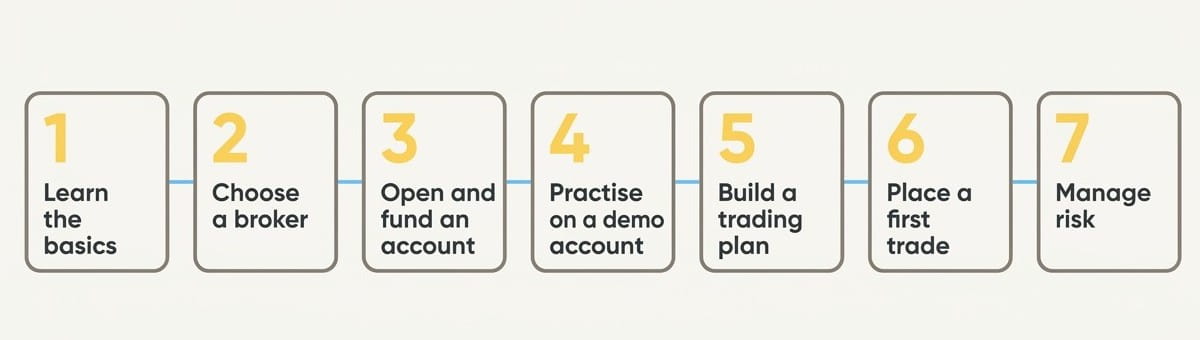
Seven steps are a sequence many traders follow before a live CFD position.
- Learn the basics.
- Choose a broker.
- Open and fund an account.
- Practise on a demo account.
- Build a trading plan.
- Place a first trade.
- Manage risk.
Step 1: learn the basics
Five terms come first in CFD trading: spread, margin, leverage, stop-loss and contract size. Broker education materials, webinars and courses cover them. The Libertex education section runs as a sequence of numbered lessons.
Step 2: choose a broker
Six criteria shape the choice of CFD provider:
- Legal documents: entity, client agreement, margin call and stop-out rules.
- Costs: spread, commission and overnight funding.
- Platform usability: order types and charts on the trading platform.
- Range of markets: asset classes and instruments available.
- Customer support: languages, channels and hours.
- Demo account: virtual funds before a live position.
Offshore entities of unclear status are a known concern, so the documents come first.
Step 3: open and fund an account
Identity verification (KYC) is a standard step tied to anti-money-laundering rules. The live minimum deposit on the Libertex demo-account page is $10, checked 18.10.2026, and can vary by region. A smaller balance supports a smaller CFD position and leaves less margin room.
Step 4: practise on a demo account
The Libertex demo account holds $50,000 in virtual funds with no deposit and is resettable, checked 18.10.2026. It runs in the provider's own app, MetaTrader 4 and MetaTrader 5, and suits testing order types and a plan. A demo does not reproduce real market conditions in full, and results differ under emotional pressure.
Step 5: build a trading plan
A CFD trading plan sets objectives, risk tolerance, markets, entry and exit rules and a position size before any trade. One template covers six fields: instrument; direction; entry; stop-loss; take-profit; size. A plan reduces reactive decisions; none removes the possibility of a loss.
Markets a trader already follows
A narrow CFD focus, such as one index or one major currency pair, lowers the information to track. Market hours and release calendars then cover fewer sessions.
Step 6: place a first trade (worked example)
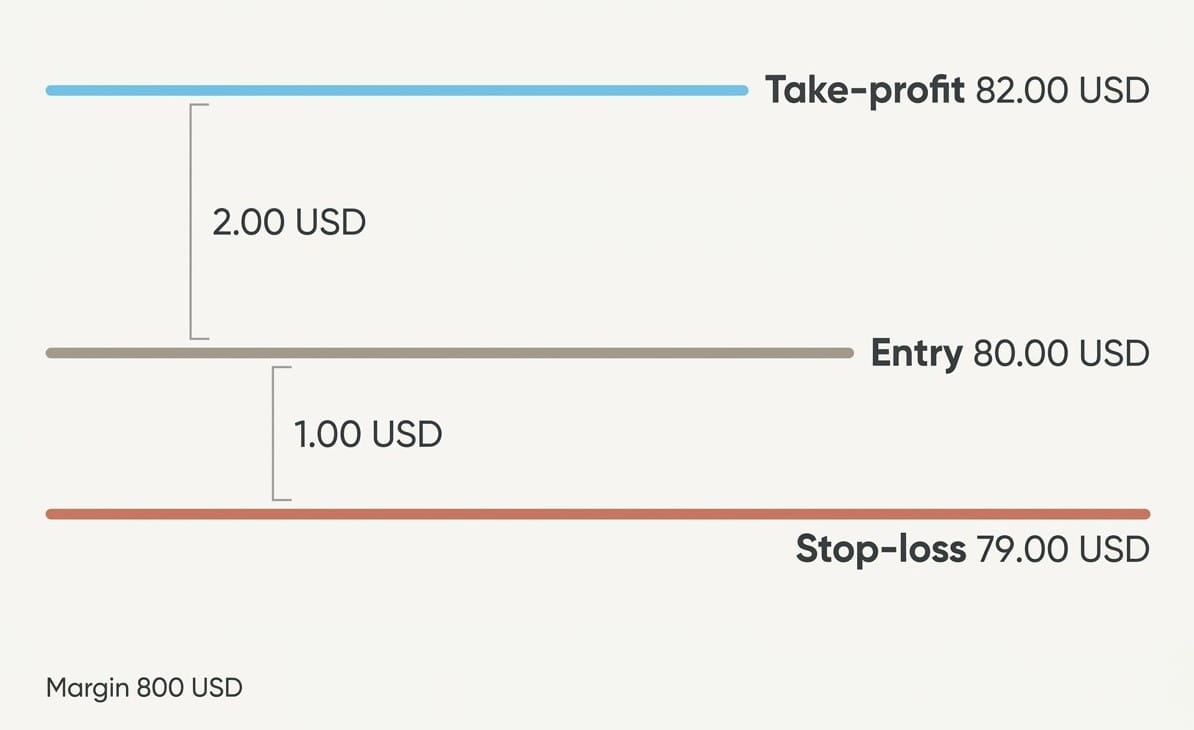
Example with fictional figures. A trader opens one crude oil CFD contract of 100 barrels. The long entry is $80.00, a position value of $8,000. At 10:1 the margin is $800.
On that same fictional crude oil CFD, a stop-loss at $79.00 risks $100 and a take-profit at $82.00 targets $200. The trade closes at the take-profit. A stop-loss is not assured to fill at $79.00, because fast markets produce slippage.
Step 7: manage risk with stop-loss, take-profit and position sizing
A stop-loss closes a CFD position at a set loss, and a take-profit closes it at a set gain. Both are orders set in advance. Position sizing controls the risk per trade, and a commonly cited approach limits it to 1-2% of the account.
Example with fictional figures: on an account of $5,000, 2% is $100. A stop-loss $1.00 below the entry on a 100-barrel position puts $100 at risk.
Standard and guaranteed stop-loss orders
A standard stop-loss is exposed to slippage, while an IOSCO survey records some providers offering guaranteed stop-loss orders for a fee. Slippage is execution at a price different from the one requested.
CFD costs and how profit and loss is calculated
Costs reduce the result of every CFD trade, which makes them part of any plan. Three cost types apply: the spread, a commission where the instrument carries one, and overnight funding. Cost types come first, then a worked calculation.
Spreads, commissions and overnight funding
The spread is the gap between buy and sell price, paid on opening a CFD. A commission may apply on share CFDs.
Overnight funding is charged or credited past the daily close, usually at a reference interest rate plus a provider markup. Some contracts carry an expiry date in the instrument specification. Check current costs of each instrument on the trading platform of the provider.
Calculating profit and loss: a worked example
Profit and loss on a long CFD equals closing price minus opening price, times position size. Costs come off that result. A short CFD reverses the first term.
Example with fictional figures: a long position of 100 barrels of crude oil opens at $80.00. The spread cost is $0.05 per barrel, or $5.
| Long crude oil CFD, 100 barrels | Outcome A: take-profit | Outcome B: stop-loss |
| Closing price | $82.00 | $79.00 |
| Price difference | +$2.00 | -$1.00 |
| Result before costs | +$200 | -$100 |
| Spread cost ($0.05 × 100 barrels) | -$5 | -$5 |
| Result after costs | +$195 | -$105 |
Trading styles used with CFDs
CFD trading style follows the time a trader has, the tolerance to loss and the knowledge of a market. No style carries less risk in every case, and none is free of risk. Styles apply across forex, shares, commodities, indices and CFDs on cryptocurrencies.
Trading around scheduled events
Traders position around central bank decisions, earnings releases and economic data to follow short-term volatility. An economic calendar lists the dates. The same releases widen spreads, open gaps and reverse prices quickly. Risk and possibility carry equal weight here.
Day trading, position trading and scalping compared
Three CFD styles sit along one axis: how long a position stays open. Holding period shapes the analytical approach, the commitment and how heavily costs weigh. Trading a pullback usually falls into day trading or scalping.
Illustrative comparison:
| Feature | Day trading | Position trading | Scalping |
| Holding period | Minutes to hours, same session | Weeks to months | Seconds to minutes |
| Analytical approach | Mainly technical | Technical and fundamental | Technical |
| Commitment | Several hours a day | A few hours a week | Continuous screen time |
| Risk profile | Risk present; costs rise with trade count | Risk present; funding accumulates | Risk present; costs rise sharply |
Common CFD trading mistakes
Six mistakes recur in CFD trading, each with a mechanism and a counter-measure.
- Overleveraging: at 10:1 a 10% adverse move erases the margin. Sizing set before entry caps exposure.
- No stop-loss: a position can run past the loss accepted. A stop-loss caps it, subject to slippage.
- Overtrading: a high trade count raises total costs. A trade limit holds it down.
- Ignoring costs: overnight funding accumulates past the daily close. Specifications list each current cost.
- Trading without a plan: entries chosen in the moment follow sentiment. Written rules fix them first.
- Letting losses run: hope enlarges a losing position. A pre-set exit closes it.
Conclusion
Five elements sit before and alongside live CFD trading. Knowledge of the terms, a provider with clear legal documents and practice with virtual funds come first.
A written plan and risk management then run through every position, before and during live trading. Risk awareness is continuing work, not a single step.
FAQ
How do you start CFD trading?
Starting CFD trading takes seven steps. Traders learn the terms, then choose a provider after reading its legal documents. An account and identity verification follow. Practice on a demo account comes next, then a written plan and a first trade managed with a stop-loss.
Is CFD trading suitable for someone new to this market?
Suitability depends on the person and the loss that person can accept, because CFDs combine leverage with fast price changes. Barber, Lee, Liu and Odean found fewer than 1% of Taiwanese day traders earned positive abnormal returns after costs (2014, checked 18.10.2026). This is information, not personalised investment advice.
Is CFD trading risky?
Yes. Leverage multiplies losses as it multiplies gains, and a provider can close positions automatically when margin falls short. Costs apply to every trade. At 10:1 the margin equals 10% of the position, so a 10% adverse move equals the whole margin.
How much money is needed to start CFD trading?
The live minimum deposit on the Libertex demo account page is $10, and that page gives $50,000 in virtual funds, both checked 18.10.2026. What matters more is the loss a trader accepts per trade, and conditions differ by instrument. This is information, not investment advice.
Not financial advice. The content of this article is provided by Libertex for general information and educational purposes only. It does not constitute investment advice, investment research, a personal recommendation, or an offer or solicitation to buy or sell any financial instrument or other asset. It is general in nature and is not tailored to any individual reader, so it cannot account for your personal circumstances, financial situation, knowledge, experience, or investment objectives. Any decision to act on this content is taken at your own discretion and risk, and you remain solely responsible for assessing whether a product or strategy is right for you and for seeking independent professional advice where appropriate.
Risk warning. Trading in financial instruments and other assets, particularly leveraged products such as CFDs, is complex and carries a high risk of losing money rapidly. Leverage magnifies both gains and losses, so small market movements can lead to disproportionate losses. The value of the assets referenced may rise or fall, and you may lose your entire invested amount. Past performance is not a reliable indicator of future results. The use of artificial intelligence, algorithms, automated strategies, or any other analytical tool in trading does not guarantee any particular outcome, does not eliminate risk, and does not replace your own judgement — you remain fully responsible for assessing every instrument, strategy, and decision, and for the results of your trading.
Why trade with Libertex?
- Get access to a demo account free of charge
- Receive live technical assistance 5 days a week, 24 hours a day
- Enjoy leverage of up to 1:500
- Use a platform for any device: Libertex and MetaTrader 4 and 5
- Pay zero commission on withdrawals in Latin America
- Benefit from up to $500 protection on your first trades with Negative Trade Protection