
How to Invest in Crude Oil Without Buying It: 5 Ways to Gain Exposure in 2026
Crude oil investing means gaining financial exposure to oil prices through instruments such as ETFs, futures, stocks, or options, rather than storing physical barrels. Most retail investors access the market this way, since holding and transporting crude oil directly is impractical.
Oil is priced globally against two benchmarks: Brent Crude, which tracks international supply out of the North Sea, and West Texas Intermediate (WTI), which tracks US production. Both move on the same broad drivers — supply decisions, demand cycles, and geopolitical events — but can diverge short term due to regional supply and transport differences.
Crude oil is often treated as a portfolio diversifier, since its price cycle does not always move in step with equities. It is not a risk-free hedge like gold, but demand for oil tends to stay resilient even during weaker economic periods, since transportation and industrial use continue regardless of stock market conditions. Investors exploring how to invest in crude oil can access both CFD trading and commission-free investing in real oil-related stocks, with a demo account available for practicing strategies without risking capital.
Key Takeaways
- Crude oil can be accessed through five main instruments: ETFs, futures, individual stocks, sector ETFs, and options, each with a different risk and cost profile.
- Brent Crude and West Texas Intermediate (WTI) are the two dominant pricing benchmarks, traded on ICE and NYMEX respectively.
- Futures-based oil ETFs can suffer from contango, a cost drag from rolling expiring contracts into pricier future-dated ones.
- OPEC decisions, US dollar strength, and weekly US inventory data are among the most direct short-term price drivers.
- Oil stocks and sector ETFs are the only instruments in this list that can pay dividends.
- Leverage on CFD trading of crude oil-related instruments is available up to 30:1.
How Does Oil Trading Work?
Retail investors trade crude oil exposure through financial instruments tied to oil prices, not through physical barrels. Profit or loss comes from the direction of the price move rather than ownership of the commodity itself. WTI futures trade on the New York Mercantile Exchange (NYMEX), while Brent Crude futures trade on the Intercontinental Exchange (ICE). These futures contracts underpin most other oil investment products, including the ETFs, options, and CFDs covered below.
5 Ways to Invest in Crude Oil
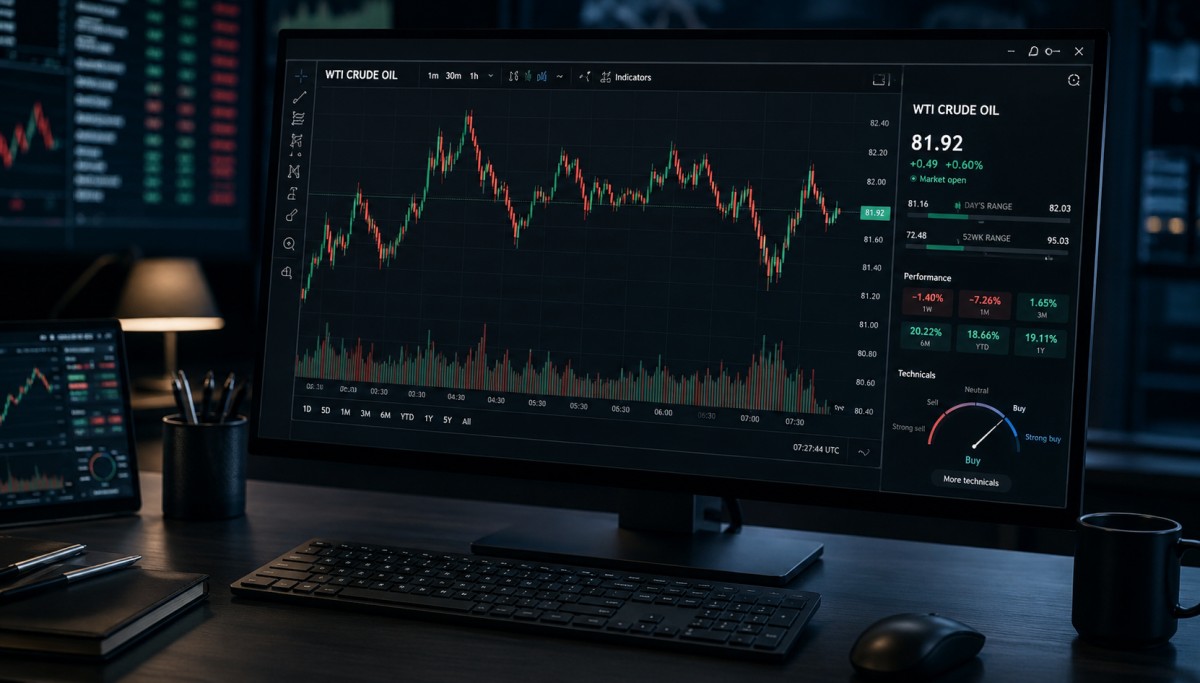
Choosing between crude oil investment methods depends on an investor's risk tolerance, time horizon, and available capital, rather than convenience alone. The comparison below outlines the five main routes before each is explained in detail; the full range of instruments for investing in crude oil is also available on the platform.
| Investment Method | Accessibility | Risk Level | Best For | Typical Cost |
| Oil ETFs | High. Standard brokerage account | Medium | Short-to-medium-term tactical exposure | Expense ratio, approximately 0.5–1% |
| Oil Futures | Low. Dedicated commodities account | High | Experienced traders | Margin plus exchange fees |
| Oil Stocks | High. Standard brokerage account | Medium | Long-term, dividend-seeking investors | Standard brokerage commission |
| Oil Stock ETFs | High. Standard brokerage account | Medium-low | Diversified, long-term exposure | Expense ratio, approximately 0.1–0.4% |
| Oil Options | Low. Options-enabled account | High | Advanced hedging or speculation | Premium plus commission |
Oil ETFs (Exchange-Traded Funds)
Oil ETFs such as the United States Oil Fund (USO) track crude oil prices by holding futures contracts, giving investors price exposure through a standard brokerage account. Because futures expire, funds must periodically roll positions into new contracts. When later-dated contracts are more expensive than the ones expiring — a condition called contango — the fund effectively sells low and buys high on every roll, creating a cost drag over time. For example, selling a contract at $70 and buying the next month's at $72 erodes returns even if the spot price stays flat. This makes futures-based oil ETFs better suited to short-to-medium-term positions than long-term holding, and expense ratios add a further cost layer. European investors typically access similar exposure through Exchange-Traded Commodities (ETCs), since UCITS diversification rules limit single-commodity ETFs; ETCs track the same Brent Crude or WTI futures indices.
Oil Futures Contracts
Oil futures are the foundational instrument behind most other crude oil products. WTI futures trade on NYMEX, while Brent Crude futures trade on ICE, and both let traders lock in a price for delivery at a future date. The futures price differs from the spot price, which reflects the cost of immediate delivery. Leverage can amplify both gains and losses, and trading futures directly requires a dedicated commodities brokerage account with higher capital minimums than a standard account. Most retail investors approach crude oil futures indirectly instead, through futures-based ETFs or oil company stocks.
Oil Stocks: Investing in Oil-Producing Companies
The petroleum industry spans three segments: integrated majors such as ExxonMobil, Chevron, Shell, and BP; upstream exploration and production (E&P) companies; and midstream or downstream businesses. Because production costs are relatively fixed, a moderate rise in the price per barrel can translate into a much larger increase in earnings for lean producers, an effect known as operating leverage. Balance sheet strength and debt levels are worth checking, since heavily indebted producers are more exposed to price downturns. Unlike futures or commodity ETFs, oil stocks can pay dividends, adding an income component to potential returns.
Oil Stock ETFs and Sector Funds
Oil stock ETFs such as XLE, VDE, and XOP hold shares of oil and gas companies rather than tracking crude prices directly. Their correlation with oil prices is meaningful but imperfect, since company-level factors like balance sheets and management quality also affect returns. Diversifying across dozens of companies through a single fund lowers company-specific risk while retaining sector-level oil exposure, and expense ratios are typically lower than actively managed funds. It is worth checking a fund's holdings, since some sector ETFs include utilities or renewable energy exposure that dilutes pure oil sector concentration.
Oil Options
A call option gives the right, not the obligation, to buy an asset at a set price before expiry, while a put option gives the right to sell. In crude oil, options are used either for leveraged directional speculation or to hedge an existing position against downside risk. Pricing involves strike prices, expiry dates, premiums, and implied volatility, making options considerably more complex than ETFs or stocks. Options on oil ETFs such as USO are generally more accessible than options on futures contracts directly, and this instrument is best suited to experienced investors rather than beginners.
Key Factors That Move Crude Oil Prices
Understanding what drives crude oil prices helps investors judge position sizing, timing, and exit points rather than reacting to headlines. The five factors below — supply decisions, demand cycles, geopolitics, currency and inventory data, and the energy transition — account for most short- and long-term price movement.
OPEC and Global Supply Decisions
OPEC, the Organisation of the Petroleum Exporting Countries, coordinates production across 13 member nations and works alongside additional producers, including Russia, under the OPEC+ arrangement. Announcements of production cuts typically push prices higher, while output increases tend to compress them, making OPEC meeting dates a useful calendar event for investors to track. The growth of US shale production has reduced OPEC's unilateral pricing power by adding a more price-responsive, non-OPEC supply source to the market.
Global Economic Growth and Energy Demand
Crude oil demand tracks industrial activity, transportation, and manufacturing output, so it typically rises during economic expansions and falls during slowdowns. China and India remain the largest sources of incremental demand growth in the current cycle. Leading indicators worth monitoring include PMI data, GDP growth forecasts, and freight volumes, all of which can signal shifts in oil demand before they show up in price.
Geopolitical Events and Supply Disruptions
A large share of global crude oil reserves sits in politically sensitive regions, which is the structural source of the geopolitical risk premium built into oil prices. Conflicts, sanctions, and shipping disruptions — particularly around chokepoints such as the Strait of Hormuz — can restrict supply quickly and push prices higher. Investors should treat geopolitical risk as an ongoing input to fair-value estimates rather than a one-off event.
US Dollar Strength and Inventory Data
Since crude oil is priced globally in US dollars, a stronger dollar raises the effective cost for non-dollar buyers and tends to reduce demand and pressure prices, while a weaker dollar has the opposite effect. The US Energy Information Administration (EIA) publishes a weekly petroleum status report every Wednesday, and inventory builds or draws in that report are a key short-term price catalyst.
The Push for Alternative Energy Sources
Electric vehicle adoption, renewable electricity, and efficiency gains are gradually reducing oil's share of the global energy mix, but this shift unfolds over decades rather than years. Near-to-medium-term demand remains resilient, particularly in developing economies, so this is a long-term consideration rather than an immediate price driver.
How to Choose the Right Crude Oil Investment for Your Profile
Beginner and long-term investors are typically better suited to oil stock ETFs such as XLE or VDE, which spread risk across many companies and can include dividend income. Intermediate investors comfortable with more active decisions may use commodity ETFs for directional exposure or select individual oil stocks for a targeted position. Experienced traders looking for leveraged, short-term exposure tend to use futures or options, both of which require closer monitoring and a clear exit plan.
A few points apply regardless of instrument: contango can erode returns in futures-based ETFs held for long periods, concentrating capital in a single oil stock adds company-specific risk, and any use of leverage should come with a defined exit strategy set in advance. No crude oil investment vehicle is inherently low-risk. Before choosing one, ask three questions: What is my time horizon? How much of a loss could I tolerate? And how closely can I monitor the position?
Step-by-Step: How to Make Your First Crude Oil Investment
- Learn the fundamentals: understand the WTI and Brent benchmarks, the main price drivers, and reliable data sources such as EIA.gov and OPEC production reports.
- Define your goals and risk tolerance, including how much capital you are willing to allocate and for how long.
- Select an investment vehicle using the framework above, based on your investor profile.
- Choose a broker that supports your chosen instrument. Futures and options generally require a dedicated commodities account.
- Open and fund your account, keeping in mind that futures accounts often carry higher minimums than standard brokerage accounts.
- Monitor your position using price alerts, EIA weekly data, and OPEC meeting dates, and define your target price and stop-loss level before committing capital.
How to Monitor and Manage Your Oil Position Over Time
Managing a crude oil position is an active process rather than a passive, buy-and-hold exercise, especially for futures or options traders. Useful habits include tracking the Wednesday EIA inventory report, following OPEC meeting dates, watching macro indicators such as GDP and PMI, setting brokerage price alerts, and reviewing your position thesis quarterly. Active traders may also use technical tools such as MACD, Bollinger Bands, and moving averages as additional analytical input.
FAQ
Can I directly invest in crude oil?
Not practically. Physically storing and transporting barrels of crude oil is impractical for retail investors. Exposure is typically gained instead through instruments such as oil ETFs, futures, stocks, sector funds, or options, which track or derive from crude oil prices without physical ownership.
What are the different ways to invest in crude oil?
There are five main routes: oil ETFs that track futures prices, oil futures contracts traded directly, shares of oil-producing companies, sector ETFs holding baskets of oil stocks, and options for hedging or leveraged speculation. Each balances accessibility, cost, and risk differently.
Is crude oil a good investment?
It depends on the instrument and time horizon. Crude oil prices are volatile and cyclical, and futures-based products can suffer from contango over time. Oil stocks and sector ETFs add a dividend component unavailable in pure commodity exposure, which suits some long-term investors better.
What is the difference between oil ETFs and oil futures?
Oil ETFs hold futures contracts on an investor's behalf and are accessible through a standard brokerage account. Oil futures are the underlying contracts themselves, traded directly on exchanges such as NYMEX and ICE, and generally require a dedicated commodities account with higher capital minimums.
How do I invest in oil stocks vs oil ETFs?
Oil stocks involve buying shares of individual producers through a standard brokerage account. Oil stock ETFs, such as XLE or VDE, spread that exposure across many companies in a single fund, reducing company-specific risk while retaining sector-level exposure to oil prices.
What are the main risks associated with investing in crude oil?
Key risks include contango eroding returns in futures-based ETFs, overconcentration in a single oil stock, leverage amplifying losses in futures and options trading without a defined exit plan, and currency exposure for non-USD investors holding dollar-denominated instruments.
What factors affect the price of crude oil?
Crude oil prices respond to OPEC production decisions, global economic growth and demand, geopolitical events affecting supply, US dollar strength, and weekly US inventory data. Longer-term, the shift toward alternative energy sources also affects demand expectations, though its price impact unfolds over decades.
Is there step-by-step guidance on how I can invest in crude oil?
Learn the fundamentals and benchmarks, then define your goals and risk tolerance. Select an investment vehicle matching your profile, choose a broker that supports it, open and fund your account, and monitor the position using price alerts and EIA data, always defining an exit strategy first.
Not financial advice. The content of this article is provided by Libertex for general information and educational purposes only. It does not constitute investment advice, investment research, a personal recommendation, or an offer or solicitation to buy or sell any financial instrument or other asset. It is general in nature and is not tailored to any individual reader, so it cannot account for your personal circumstances, financial situation, knowledge, experience, or investment objectives. Any decision to act on this content is taken at your own discretion and risk, and you remain solely responsible for assessing whether a product or strategy is right for you and for seeking independent professional advice where appropriate.
Risk warning. Trading in financial instruments and other assets, particularly leveraged products such as CFDs, is complex and carries a high risk of losing money rapidly. Leverage magnifies both gains and losses, so small market movements can lead to disproportionate losses. The value of the assets referenced may rise or fall, and you may lose your entire invested amount. Past performance is not a reliable indicator of future results. The use of artificial intelligence, algorithms, automated strategies, or any other analytical tool in trading does not guarantee any particular outcome, does not eliminate risk, and does not replace your own judgement — you remain fully responsible for assessing every instrument, strategy, and decision, and for the results of your trading.
Why trade with Libertex?
- Get access to a demo account free of charge
- Receive live technical assistance 5 days a week, 24 hours a day
- Enjoy leverage of up to 1:500
- Use a platform for any device: Libertex and MetaTrader 4 and 5
- Pay zero commission on withdrawals in Latin America
- Benefit from up to $500 protection on your first trades with Negative Trade Protection