
Is Tesla (TSLA) a Good Stock to Buy?
Tesla can be a good stock to buy — but the answer depends entirely on the investor profile, time horizon, and the valuation framework applied. This is a company in active fundamental transformation: it was founded as an electric vehicle manufacturer, but is increasingly being valued as an AI platform, an energy company, and an autonomy play. The investment case is structurally compelling over the long term for investors who understand and accept the associated risks.
Whether you are considering investing in Tesla shares through Libertex or simply evaluating TSLA as part of your research, this article breaks down the company's business model, valuation, and the strongest arguments on both sides of the debate.
Key Takeaways
- Tesla is no longer purely an EV manufacturer — it is increasingly positioned as an AI platform, energy storage company, and autonomy business, which fundamentally changes how analysts approach its valuation.
- TSLA trades at elevated multiples relative to traditional automotive peers, reflecting market expectations of future growth in autonomous driving, robotics, and energy, not current earnings alone.
- The bull case centres on autonomy (Robotaxi / Cybercab), AI compute buildout, and the energy segment; the bear case centres on EV margin compression, competitive pressure, and execution risk.
- Tesla does not pay a dividend — it is a growth and capital appreciation vehicle, not an income stock.
- Investors can gain exposure to Tesla shares or trade TSLA CFDs through Libertex, depending on their strategy and risk tolerance.
Tesla Motors: How It Started
Tesla Inc. was founded by Marc Tarpenning and Martin Eberhard in 2003 as Tesla Motors. The main idea was to produce electric sports cars. Lots of Tesla investors evaluated the company's approach and put their money in it.
One of them was Elon Musk, who invested more than $30 million. He became Tesla's chairman in 2004. By 2009, both founders had left the company, and Mr Musk became the CEO.
In 2008, the company created a Roadster, the first fully electric car capable of competing with petrol vehicles on performance. For years, the company had been developing its car versions. In 2012, it launched fast-charging facilities for Tesla users. As the company started focusing not only on cars, it was renamed to Tesla Inc in 2017. In 2018, the company entered the solar energy market.
Tesla entered the stock market in 2010. Since 29 June 2010, the company has been listed on the Nasdaq Stock Exchange under the ticker TSLA. Tesla Motorsbecame the first US car manufacturer to enter the stock market since 1956, when Ford Motor Company went public.
What Kind of Company Is Tesla Actually?
Most investors who purchase TSLA are not simply buying an electric vehicle manufacturer — they are buying exposure to an AI platform, an energy storage business, and an autonomy play. This classification matters enormously because it determines the appropriate valuation framework and peer group. Would any rational analyst value a car company at 150x earnings? The elevated multiple that Tesla consistently commands reflects market pricing of something considerably larger than automotive sales.
Even institutional analysts at Morningstar acknowledge the classification challenge: Tesla does not fit cleanly into automotive or technology peer groups, because it is genuinely operating across both — and beyond both. The analogy sometimes drawn is to Amazon in 2005: a company whose surface business (e-commerce / electric vehicles) obscured the real long-term value driver (AWS / autonomy and AI).
Tesla's Core Business Segments
Tesla operates across four primary revenue segments:
- Automotive sales: The Model 3 and Model Y remain the volume backbone of the business, with the Tesla Semi targeting commercial fleet adoption.
- Energy generation and storage: The fastest-growing and most profitably surprising segment in recent quarters; Powerwall, Megapack, and Solar Roof products serve residential and utility-scale markets.
- Services: Supercharging, insurance, and over-the-air software updates generate high-margin recurring revenue that most retail investors consistently underweight in their analysis.
- AI and autonomy: Full Self-Driving (FSD), the Robotaxi / Cybercab programme, and Optimus humanoid robotics represent the segment where the long-term bull case is concentrated. This segment generates limited revenue today but accounts for a significant share of TSLA's market capitalisation on a forward-looking basis.
Tesla's Strategic Pivot: From EV Manufacturer to AI-First Industrial Platform
Tesla's deliberate shift toward AI, autonomy, and humanoid robotics represents either the most compelling growth story in the public equity markets, or an extraordinary concentration of execution risk — depending on which assumptions prove correct. The company has committed to a $20 billion-plus capital expenditure programme targeting AI chip fabrication, expanded compute capacity, and advanced manufacturing, positioning Tesla as one of the largest private AI compute operators globally.
The Robotaxi / Cybercab programme and Optimus robot are the highest-conviction long-term value drivers in the bull case. Tesla Autopilot and Full Self-Driving are the enabling technology layers. The autonomous vehicle landscape is genuinely competitive. Waymo operates a commercial robotaxi service in multiple US cities, but Tesla's advantage lies in its unmatched real-world FSD training data from millions of vehicles on public roads.
Tesla Stock Valuation: What the Numbers Tell Us
Tesla's valuation is the single most contested argument in the investment debate around TSLA. Elevated multiples are not, on their own, a reason to avoid a stock. They are a reason to understand precisely what growth assumptions the market is pricing in, and whether those assumptions are defensible.
TSLA trades at a significant premium to both traditional automotive peers and to its own historical average on a price-to-earnings basis. This premium reflects market pricing of the autonomy and AI segments, not the core EV business. Analysts who model Tesla purely on automotive earnings arrive at substantially lower fair value estimates than those who model the autonomy upside scenario. The spread between these two analytical approaches explains much of the persistent disagreement between bulls and bears.
Key financial context investors typically reference when evaluating TSLA:
- Trailing and forward P/E. Tesla's trailing P/E is significantly elevated relative to the automotive sector. The forward P/E, based on consensus EPS forecasts for 2027–2028, is more moderate but still reflects a substantial growth premium.
- Net cash position. Tesla maintains a strong balance sheet with substantial net cash, providing a multi-year transformation runway without requiring dilutive equity financing.
- Morningstar uncertainty rating. Morningstar assigns Tesla a Very High uncertainty rating, reflecting the wide range of plausible outcomes across the autonomy and AI segments. This is institutional confirmation of the risk that both bulls and bears acknowledge.
- DCF fair value. Discounted cash flow models for TSLA vary widely depending on assumptions about FSD monetisation, Robotaxi adoption rates, and energy segment growth. Analysts who assign material probability to the autonomy scenario arrive at significantly higher fair value estimates than those who discount it entirely.
The Bull Case and Bear Case for Tesla Stock
As of late 2025, over 130 hedge fund portfolios held TSLA, which shows institutional conviction that the risk/reward profile remains compelling for sophisticated long-term investors. Understanding both sides of the debate is a prerequisite for making an informed decision about TSLA.
The Bull Case: Five Strongest Arguments for Tesla
- Autonomy as the primary value driver. The Robotaxi / Cybercab programme and FSD technology represent the dominant component of Tesla's long-term valuation on a forward-looking basis. If autonomous ride-hailing scales commercially, the revenue and margin profile of the business transforms entirely relative to today's automotive earnings baseline.
- AI compute buildout. Tesla's $20B+ capital expenditure programme targeting AI chip fabrication and expanded compute capacity positions the company as a major private AI compute operator, a strategic asset that extends well beyond vehicle manufacturing.
- Energy segment as an undervalued growth engine. The energy generation and storage business has been consistently surprising to the upside in recent quarters and remains significantly underweighted by retail investors who focus exclusively on automotive delivery numbers.
- Balance sheet strength. A strong net cash position provides a multi-year transformation runway without requiring dilutive financing, reducing execution risk at the capital structure level even if the timeline for autonomy monetisation extends further than currently projected.
- Growing institutional conviction. The increase in hedge fund positions in TSLA reflects growing institutional confidence that the AI and autonomy pivot represents a credible value creation path, not merely a speculative narrative.
The Bear Case: Key Risks Every Tesla Investor Must Understand
Understanding the bear case is not pessimism; it's intellectual honesty. The primary risks institutional bears cite:
- EV margin compression and competitive pressure. BYD has overtaken Tesla in Chinese EV sales, and pricing pressure across the electric vehicle market has compressed automotive gross margins. If the core EV business deteriorates faster than autonomy scales, the financial bridge to the AI future narrows.
- Autonomous driving competition. Waymo operates a commercial robotaxi service in multiple US cities today, while Tesla FSD remains a supervised driver-assistance system subject to ongoing regulatory review. The gap between Tesla's current FSD capability and fully commercial autonomous operation represents a material execution risk.
- Elon Musk's distraction and brand risk. Musk's simultaneous leadership of Tesla, SpaceX, xAI, and political advisory roles creates documented attention fragmentation. European consumer sentiment data shows measurable brand damage in key markets — a risk that is difficult to quantify but real in its impact on delivery volumes.
- ESG-driven institutional restrictions. A growing number of ESG-mandated institutional funds face restrictions on TSLA exposure due to governance and leadership concerns, reducing the pool of potential institutional buyers.
- Valuation risk: right company, wrong price. Even if Tesla executes flawlessly on autonomy, energy, and AI, investors who purchase at significantly elevated multiples may face poor returns if the timeline extends or if the market re-rates the stock during a period of macro pressure or rising discount rates. Morningstar's Very High uncertainty rating is the institutional expression of this risk.
Is Tesla a Reliable Investment?
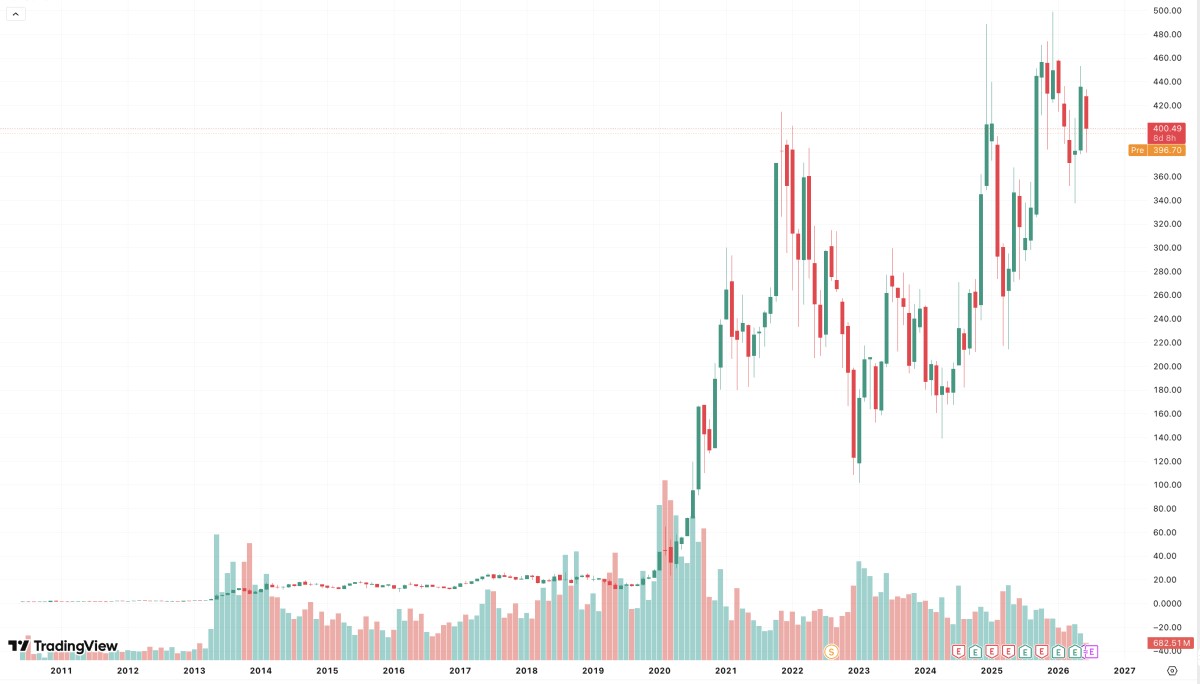
Usually, stocks of car producers are stable. If we consider a chart of Tesla shares, we will see that they are highly volatile. The company's stocks strongly depend on the quarterly earnings reports, Musk's announcements, and product releases.
In 2018, the company's stocks skyrocketed, and the NASDAQ had to halt them after Elon Musk tweeted about the willingness to take Tesla private at $420. The most paradoxical thing is that the information wasn't confirmed, but was released as a tweet. On 1 May 2020, the stocks plunged after Mr Musk tweeted he thought they were too high. The shares lost nearly 12% within 30 minutes.
This event pattern — sharp price moves triggered by CEO communications rather than fundamental business developments — remains one of Tesla's most distinctive characteristics as an investable asset. It's neither purely positive nor purely negative, but it is a defining feature that investors should factor into their risk assessment.
Is Tesla Stock a Buy, Sell, or Hold Right Now?
The answer to whether Tesla is a good stock to buy depends less on the company itself than on the investor evaluating it.
For the long-term growth investor with a five-plus-year horizon, high risk tolerance, and conviction in the autonomy and AI thesis. Tesla's structural growth story remains compelling. The energy segment provides a growing, underappreciated earnings base, and the balance sheet strength reduces financing risk during the transformation period.
For the value-oriented investor focused on current earnings and near-term margin expansion. The elevated valuation multiples and Very High Morningstar uncertainty rating make TSLA a difficult fit. The stock is priced for a future that has not yet materialised, and value investors may find more attractive risk/reward elsewhere.
For the conservative or income-focused investor. Tesla does not pay a dividend, carries significant execution risk across multiple simultaneous transformation programmes, and exhibits substantially higher volatility than the broader market. It is unlikely to be suitable as a core holding for capital preservation or income objectives.
Thus, Tesla stocks are an excellent option for those traders and investors who feel comfortable in highly volatile markets. The key is understanding which investor profile applies to your own situation before making a decision.
Investors can access Tesla shares or trade TSLA CFDs through the Libertex platform. A demo account allows you to observe how Tesla shares move across different timeframes and market conditions before committing real capital.
How to Reduce Risks Dealing with Tesla Shares
In general, stocks are risky assets, but Tesla stocks bring even more risks to traders and investors. There are several rules that will help you prevent possible losses or at least reduce them while trading Tesla stocks.
- Analyse the market. There are several analytical approaches you can use to predict market direction.
- Practise. There is nothing better than practice and learning from your own mistakes. To avoid risking real capital while learning, you can open a Demo account. Libertex offers this option.
- Choose a trustworthy broker. No matter how well you analyse the market, if your broker is dishonest, you will lose. Check the terms and conditions, the law under which the broker provides its services, and the platform you will use while trading.
- Understand position sizing. Given Tesla's volatility, sizing positions appropriately relative to overall portfolio exposure is particularly important. A small adverse move in TSLA can have an outsized impact if the position is oversized.
- Monitor CEO communications. As the historical price moves above illustrate, public statements by Elon Musk — whether on social media or in public forums — have repeatedly caused sharp short-term price dislocations in TSLA, independent of fundamental developments. Staying aware of this dynamic is part of managing Tesla-specific risk.
Conclusion
Tesla stocks offer both compelling long-term opportunities and material short-term risks. Thus, if investors or traders want to deal with these shares, they should be careful and follow money management. Tesla is best understood not as a car company, but as an AI and autonomy platform in active transformation, and should be evaluated accordingly.
Whether the investment case is right for you depends on your time horizon, risk tolerance, and conviction in the autonomy and energy growth thesis. As with any investment decision, independent research and consideration of your personal financial circumstances should precede any trading or investment activity.
FAQ
Is TSLA a good stock to buy right now?
Tesla can be a good stock to buy for long-term growth investors with high risk tolerance and conviction in the autonomy and AI thesis. For value-oriented or income-focused investors, the elevated valuation and absence of a dividend make it a more difficult fit. The answer depends on the investor profile, not on the stock in isolation.
What are the main arguments for investing in Tesla stock?
The strongest bull arguments are: autonomy (Robotaxi / Cybercab) as the primary long-term value driver, AI compute buildout positioning Tesla as a major private compute operator, the energy segment as an undervalued growth engine, balance sheet strength providing a multi-year transformation runway, and growing institutional conviction evidenced by hedge fund accumulation.
What are the main risks of investing in Tesla stock?
The primary bear arguments are: EV margin compression and Chinese competitive pressure (BYD), Waymo's operational commercial robotaxi service versus Tesla FSD's current supervised status, Elon Musk distraction and political brand-damage risk with measurable consumer sentiment impact in Europe, ESG-driven institutional restrictions, and valuation risk. This is the "right company, wrong price" scenario.
What is Tesla's strategic pivot toward AI and autonomy?
Tesla has committed $20 billion-plus in capital expenditure toward AI chip fabrication, expanded compute capacity, and advanced manufacturing, positioning it as one of the largest private AI compute operators globally. The Robotaxi / Cybercab programme and Optimus humanoid robot are the primary products of this pivot, alongside Full Self-Driving software.
Does Tesla pay a dividend?
No. Tesla does not pay a dividend. It is a growth and capital appreciation vehicle. Profits and cash flow are reinvested into the business rather than distributed to shareholders. Income-focused investors should factor this into their assessment of TSLA's suitability for their portfolio.
Not financial advice. The content of this article is provided by Libertex for general information and educational purposes only. It does not constitute investment advice, investment research, a personal recommendation, or an offer or solicitation to buy or sell any financial instrument or other asset. It is general in nature and is not tailored to any individual reader, so it cannot account for your personal circumstances, financial situation, knowledge, experience, or investment objectives. Any decision to act on this content is taken at your own discretion and risk, and you remain solely responsible for assessing whether a product or strategy is right for you and for seeking independent professional advice where appropriate.
Risk warning. Trading in financial instruments and other assets, particularly leveraged products such as CFDs, is complex and carries a high risk of losing money rapidly. Leverage magnifies both gains and losses, so small market movements can lead to disproportionate losses. The value of the assets referenced may rise or fall, and you may lose your entire invested amount. Past performance is not a reliable indicator of future results. The use of artificial intelligence, algorithms, automated strategies, or any other analytical tool in trading does not guarantee any particular outcome, does not eliminate risk, and does not replace your own judgement — you remain fully responsible for assessing every instrument, strategy, and decision, and for the results of your trading.
Why trade with Libertex?
- Get access to a demo account free of charge
- Receive live technical assistance 5 days a week, 24 hours a day
- Enjoy leverage of up to 1:500
- Use a platform for any device: Libertex and MetaTrader 4 and 5
- Pay zero commission on withdrawals in Latin America
- Benefit from up to $500 protection on your first trades with Negative Trade Protection