
OpenAI Pre-IPO: How to Invest via Libertex Before the Company Goes Public
OpenAI pre-IPO refers to gaining exposure to the company behind ChatGPT before it goes public. The company submitted a confidential draft S-1 registration statement to the U.S. Securities and Exchange Commission (SEC) on 22 May 2026, marking the first formal step toward a possible initial public offering. At the time of writing (22 June 2026), however, OpenAI has not announced a listing date, stock ticker, or public share price.
Investors searching for "OpenAI pre-IPO" assume the company is already preparing to go public. Yet the process is still unfolding, and OpenAI has stated it has not made a final decision on the timing of a potential IPO.
Interest continues to grow nonetheless. OpenAI sits at the centre of the artificial intelligence boom, and its products are used by businesses, developers, and consumers around the world. As a result, investors are increasingly looking for ways to gain exposure before any public listing takes place.
One route that has attracted attention is the use of pre-IPO instruments. Unlike direct share ownership, these products can provide exposure to valuation changes without requiring investors to purchase actual shares in a private company. Platforms such as Libertex have helped make select pre-IPO opportunities available to a wider audience, historically limited to institutional investors and private-market participants.
OpenAI Pre-IPO Key Takeaways
If you're looking for the short version, here are the main points worth knowing:
- OpenAI is a private company and does not trade on public stock exchanges.
- There is currently no confirmed OpenAI IPO date.
- The company is best known for ChatGPT and the GPT family of AI models.
- Microsoft is one of OpenAI's most prominent strategic investors.
- Private-market valuation estimates have reached levels that place OpenAI among the world's most valuable private technology companies.
- Interest in OpenAI pre-IPO investment opportunities has increased alongside the broader growth of artificial intelligence.
- Pre-IPO access is uncommon, which is part of the reason these opportunities attract attention when they become available.
- Retail investors can still get exposure to OpenAI's valuation today through a CFD on Libertex, without needing institutional access or owning actual shares.
What's Happened So Far
A few dates matter here, and they're worth laying out plainly rather than burying them in a wall of text.
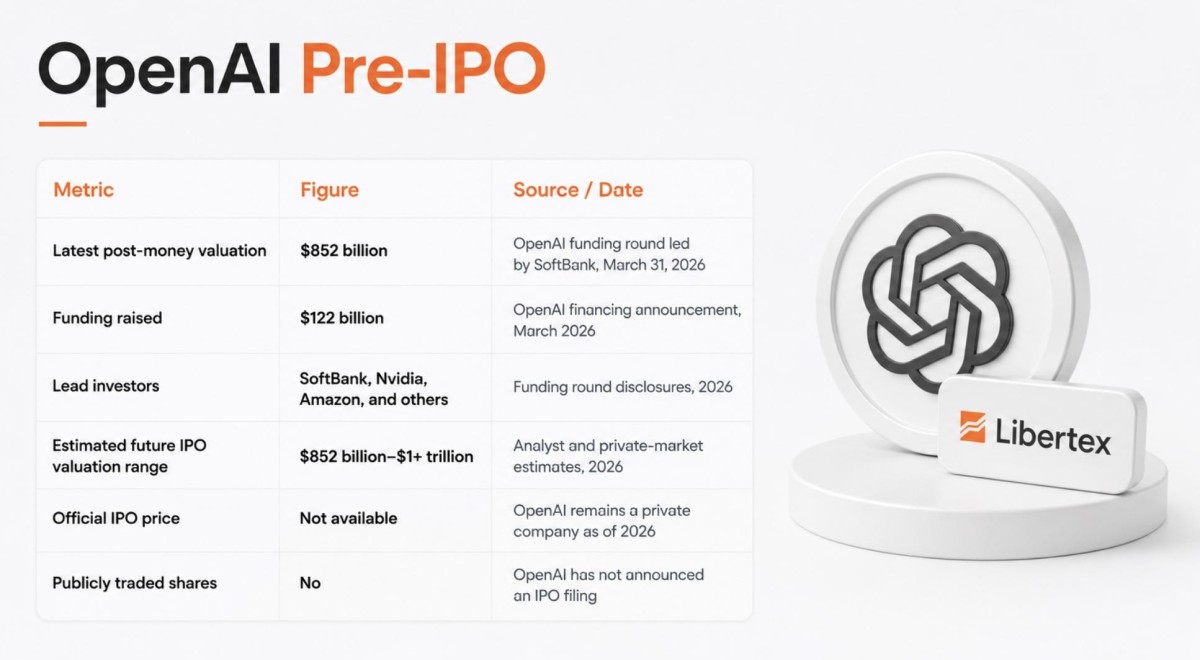
OpenAI closed a funding round on 31 March 2026, bringing in $122 billion and pushing its post-money valuation to $852 billion. SoftBank led the round, with Nvidia and Amazon also putting in serious money.
Then, on 22 May 2026, the company filed its confidential draft S-1. It didn't announce this publicly right away; the filing came to light when OpenAI confirmed it on 8 June 2026, in a short blog post that read almost like a pre-emptive move: "We recently submitted a confidential S-1. We expect it to leak, so we're just announcing it." Goldman Sachs and Morgan Stanley are reportedly leading the deal, with JPMorgan possibly involved as well.
None of that means a listing is imminent. It means the paperwork exists.
What Is OpenAI, Exactly?
OpenAI is an artificial intelligence and AI research deployment company best known for developing ChatGPT, AI models, and software tools used by businesses, developers, and consumers worldwide. Its products include ChatGPT, the OpenAI API, Codex, and advanced AI models for language, coding, and problem-solving, as well as a growing portfolio of enterprise AI solutions for tasks ranging from content generation to software development.
The organisation was founded in 2015 by a group of researchers and technology entrepreneurs that included Sam Altman, Greg Brockman, Ilya Sutskever, Elon Musk, Wojciech Zaremba, and John Schulman. What began in AI research has since evolved into one of the most influential and commercially significant companies in the AI sector.
A key development came in 2025, when OpenAI completed a corporate restructuring and became a Public Benefit Corporation (PBC). The new structure remains overseen by the nonprofit OpenAI Foundation, which continues to play a controlling role in governance. This distinction matters because it affects how investors evaluate the company's future path to the public markets. The company is headquartered in San Francisco.
OpenAI also maintains a long-term strategic partnership with Microsoft, which has invested billions of dollars in the company and integrated OpenAI technology across several of its products and services. OpenAI says its mission is to ensure that artificial general intelligence benefits all of humanity, underscoring how it frames its work to benefit society broadly.
OpenAI's Pre-IPO Valuation, Funding Rounds, and Funding
One of the most common questions surrounding OpenAI pre-IPO is whether there is already an OpenAI pre-IPO price. The short answer is no. Because OpenAI is still a private company, there is no publicly quoted share price and no official IPO price range.
What investors do have is a valuation benchmark from the company's latest funding round. On 31 March 2026, OpenAI announced the completion of a $122 billion financing round led by SoftBank, with participation from Nvidia, Amazon, and several other investors. The transaction reportedly valued the company at approximately $852 billion on a post-money basis.
It's important not to confuse valuation with share price. A private company valuation reflects what investors were willing to pay during a funding round, whereas an IPO price is determined only if and when shares are offered to the public.
Analysts following the company have suggested that a future IPO could value OpenAI somewhere between its latest private-market valuation and more than $1 trillion.
These figures are estimates rather than forecasts and should not be interpreted as a future listing price.
For now, the $852 billion valuation remains the most widely cited reference point for investors evaluating OpenAI's position ahead of a potential public offering.
How to Invest in OpenAI Private Company Stock Pre-IPO
Direct access to OpenAI pre-IPO shares is limited. Private funding rounds are typically reserved for institutional investors, venture capital firms, and selected strategic partners. In the broader market for companies like OpenAI, access to private stock or private company shares through secondary deals often requires substantial capital and may carry high fees and premiums for institutional investors and accredited buyers.
Some investors try to buy OpenAI stock through private market trading platforms. These venues are used to buy and sell shares of pre-IPO companies rather than on public exchanges.
In some cases, OpenAI stock may become available through secondary-market transactions, but it remains a privately held company security, and opportunities to buy OpenAI stock are limited.
Another approach is gaining exposure through a CFD linked to a pre-IPO asset. A CFD, or Contract for Difference, allows traders to speculate on price movements without purchasing or owning the underlying shares. This is an important distinction. A CFD does not provide ownership in OpenAI, voting rights, or the right to participate in a future IPO allocation. Instead, it reflects the reference price of the underlying asset.
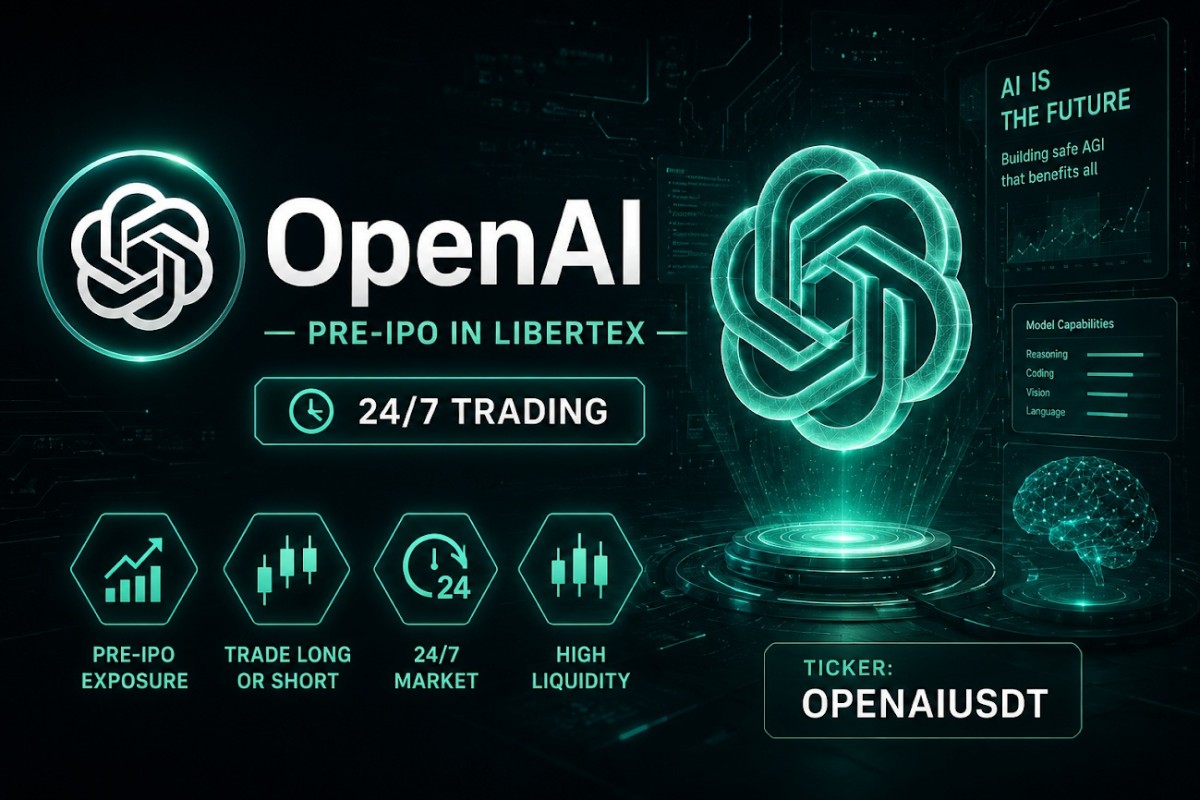
Libertex offers access to select pre-IPO CFD instruments, allowing investors to track the performance of private companies before they potentially go public. Because pre-IPO opportunities are relatively rare and not widely available through traditional investment channels, they continue to attract attention from investors interested in emerging technology companies.
How to Invest via Libertex
If you've decided a CFD is the right way to get exposure to OpenAI's valuation, the actual process is fairly standard for anyone who's used a trading platform before.
- Start by opening an account with Libertex and completing identity verification, which is required by any regulated broker before you can fund your account or place a trade.
- Deposit funds using whichever method the platform supports in your region (bank transfer, card, or a local payment option).
- Search for the OpenAI pre-IPO instrument on the platform, review the contract terms (including the spread, any overnight financing charges, and the available leverage), and decide on a position size you're comfortable with given the volatility involved.
A few things worth checking before you open a position: the margin requirement, since CFDs are leveraged and that cuts both ways; the trading hours for the instrument, which may differ from standard market hours since OpenAI isn't on an exchange; and Libertex's own risk disclosure documents, which spell out the specific terms tied to this particular contract.
As with any investment, pre-IPO exposure involves risk. Private-company valuations can change significantly, and there is no guarantee that a company will complete an IPO within a specific timeframe.
When Could OpenAI Go Public?
In its own communication, OpenAI stated that it has not yet decided on the timing of a potential offering and indicated that the process could still take some time. That remains the most authoritative guidance currently available.
Several media outlets have reported that a public listing could potentially take place between September and November 2026. These reports are based on market speculation and unnamed sources rather than official company statements. As a result, they should be viewed as estimates rather than a confirmed IPO schedule.
For now, OpenAI remains a private company, and any discussion of a listing date is provisional until the company itself makes further announcements. If OpenAI does go public, insiders are typically subject to a lock-up period of about 90–180 days before they can sell shares.
Risks and Factors to Consider
Any investment linked to a private company should be evaluated with caution, and OpenAI is no exception. This type of exposure is high risk and highly speculative, even when the company is one of the most prominent names in artificial intelligence.
One consideration is profitability. OpenAI has reported revenue of roughly $2 billion per month, reflecting strong commercial demand for products such as ChatGPT and its enterprise services. At the same time, the company continues to spend heavily on computing infrastructure, research, and AI model development. As a result, revenue growth does not automatically translate into profitability. Private companies are not required to disclose the same level of financial information as public companies, which can make due diligence more difficult.
Investors should also remember that the IPO process remains uncertain. OpenAI has filed a confidential draft S-1, but the company has not yet decided on the timing of a public offering. In some cases, companies postpone IPOs for months or even years, while others decide not to proceed at all.
Valuation is another variable. The company's latest funding round valued OpenAI at approximately $852 billion, but a private-market valuation does not guarantee the price at which shares may eventually be offered to public investors. Pre-IPO investing also involves limited liquidity, and high valuations can increase downside risk.
For those using CFDs, there are additional considerations. A CFD tracks the reference price of the underlying asset and may involve leverage, which can magnify both gains and losses. Price movements can be significant, particularly when tied to private companies, funding events, regulatory developments, or shifts in market sentiment. The AI market is evolving rapidly, and intense competition can affect market activity, valuations, and market shares. Neither past performance nor projected future results should be treated as guarantees.
As with any investment decision, some investors use exposure to disruptive technology for diversification, but those potential benefits still need to be weighed against the risks, individual objectives, risk tolerance, and financial circumstances.
Is OpenAI Pre-IPO a Good Investment?
There's no clean yes-or-no here, and anyone telling you otherwise is skipping a few steps. For someone comfortable with high volatility and a long-time horizon, private investing may fit only if you understand the risks and long holding periods, and exposure to a company at the centre of the AI race might suit a particular kind of portfolio. Exposure to disruptive private companies can diversify a portfolio, but that does not make the opportunity suitable for everyone. For someone who wants predictable returns or dislikes uncertainty around timing, this probably isn't the right fit. It depends entirely on your own risk tolerance, not on some universal answer that applies to everyone reading this.
This article is for informational purposes only and does not constitute investment advice. It is not an offer to buy or sell securities. Trading CFDs involves significant risk, including the potential loss of capital. OpenAI has not confirmed a listing date, ticker, or offering price, and any figures referenced above reflect private valuations or third-party analyst estimates rather than a market price.
FAQ
What does OpenAI pre-IPO mean?
It means gaining financial exposure to OpenAI's valuation before the company goes public. OpenAI is a privately held company, and its shares do not trade on public exchanges. There's no stock to buy on an exchange yet. What exists are private funding rounds and instruments like CFDs that track the company's estimated value.
How to invest in OpenAI pre-IPO?
Direct private-round access is mostly limited to institutional and accredited investors. Some accredited investors may buy or sell securities tied to private company stock, while others use CFDs for exposure only.
A more accessible option is a CFD on OpenAI's valuation, available on platforms like Libertex, which lets you track price movements without holding the underlying shares. In limited cases, early shareholders may use secondary platforms to provide liquidity.
What is OpenAI's pre-IPO price or valuation right now?
There's no public stock price, since OpenAI hasn't listed. The most recent confirmed figure is its $852 billion post-money valuation from the March 2026 funding round. Some private-market reference points may reflect limited market activity rather than a broad public-market price. Some analysts estimate a possible IPO valuation above $1 trillion, but that's a projection, not a set price.
Has OpenAI already filed paperwork to go public?
Yes. OpenAI submitted a confidential draft S-1 to the SEC on 22 May 2026 and confirmed the filing publicly on 8 June 2026. No date or price has been set.
Are OpenAI pre-IPO shares available to retail investors?
No. Private shares are typically reserved for institutional investors or accredited individuals through structured rounds. Selling pre-IPO shares or trying to sell OpenAI shares is usually governed by company documents, such as bylaws and shareholder agreements. In practice, holders may not be able to sell shares unless transfer rules allow it. Retail investors looking for exposure usually turn to instruments like CFDs instead.
Can I get pre-IPO exposure to OpenAI on Libertex?
Yes. Libertex offers a CFD tied to OpenAI's valuation, which lets you take a position on price movement without owning actual shares or needing institutional access. As with any CFD, it comes with leverage and the risks that go with it, so it's worth reading the platform's risk disclosure before opening a position
Is OpenAI profitable?
Not currently, based on public reporting. The company has disclosed roughly $2 billion in monthly revenue but continues to spend heavily on computer infrastructure and model training, and it hasn't reported profitability. Historical private transactions can also vary, including occasional tender offer activity rather than open-market trading.
Not financial advice. The content of this article is provided by Libertex for general information and educational purposes only. It does not constitute investment advice, investment research, a personal recommendation, or an offer or solicitation to buy or sell any financial instrument or other asset. It is general in nature and is not tailored to any individual reader, so it cannot account for your personal circumstances, financial situation, knowledge, experience, or investment objectives. Any decision to act on this content is taken at your own discretion and risk, and you remain solely responsible for assessing whether a product or strategy is right for you and for seeking independent professional advice where appropriate.
Risk warning. Trading in financial instruments and other assets, particularly leveraged products such as CFDs, is complex and carries a high risk of losing money rapidly. Leverage magnifies both gains and losses, so small market movements can lead to disproportionate losses. The value of the assets referenced may rise or fall, and you may lose your entire invested amount. Past performance is not a reliable indicator of future results. The use of artificial intelligence, algorithms, automated strategies, or any other analytical tool in trading does not guarantee any particular outcome, does not eliminate risk, and does not replace your own judgement — you remain fully responsible for assessing every instrument, strategy, and decision, and for the results of your trading.
Why trade with Libertex?
- Get access to a demo account free of charge
- Receive live technical assistance 5 days a week, 24 hours a day
- Enjoy leverage of up to 1:500
- Use a platform for any device: Libertex and MetaTrader 4 and 5
- Pay zero commission on withdrawals in Latin America
- Benefit from up to $500 protection on your first trades with Negative Trade Protection