
The Ultimate Guide to Choosing the Best Trading Platform. Types and Features Explained
Beginner traders spend weeks looking for strategies and almost no time choosing the best trading platform with the right features to meet their specific needs. Then, they open their first trades and realise the real problems are somewhere else entirely: delayed execution, confusing interfaces, hidden fees, limited charting tools or an app that freezes at the worst possible moment.
The market is crowded now. There are online trading platform providers focused on forex and CFDs, platforms built around crypto trading, stock investing apps for long-term portfolios, and professional terminals designed for experienced traders who need advanced analytics. Some work best on a desktop. Others are built almost entirely for mobile users.
This guide is not another recycled “top 10 brokers” roundup. The goal here is to explain what actually matters when comparing the best trading platforms in 2026, what features are worth paying attention to, and where platforms like Libertex fit depending on the type of trader you are trying to become.
What Is an Online Trading Platform?
An online trading platform is the software traders use to access financial markets, place orders, monitor prices, and manage investments from a PC or mobile device. It acts as the working environment between the trader and the broker that executes transactions in the market.
A lot of people confuse the broker with the platform itself, but they are not exactly the same thing.
- The broker is the financial company that holds your account, processes deposits, and executes trades.
- The platform is the interface you interact with every day, including the charts, watchlists, order windows, and portfolio dashboard you see on the screen.
Some brokers rely on third-party platforms like MetaTrader 5, which has become a standard for forex and CFD trading due to its charting tools and automation features. Others build their own proprietary platforms tailored to their audience. Some brokers use third-party platforms like MetaTrader 5, while others, including Libertex, have developed proprietary interfaces designed for faster onboarding and multi-asset trading.
Most modern platforms now work across several formats. Web-based platforms run directly in a browser and don’t require installation, which makes them convenient for casual traders or people switching between devices during the day. Desktop terminals still matter, especially for active traders who need more advanced chart layouts, algorithmic trading support, or faster execution. Mobile trading apps, meanwhile, have become surprisingly capable over the last few years. Many traders now open and manage positions entirely from their phones, especially in crypto and short-term CFD markets.
Trading Platform Types and Their Features
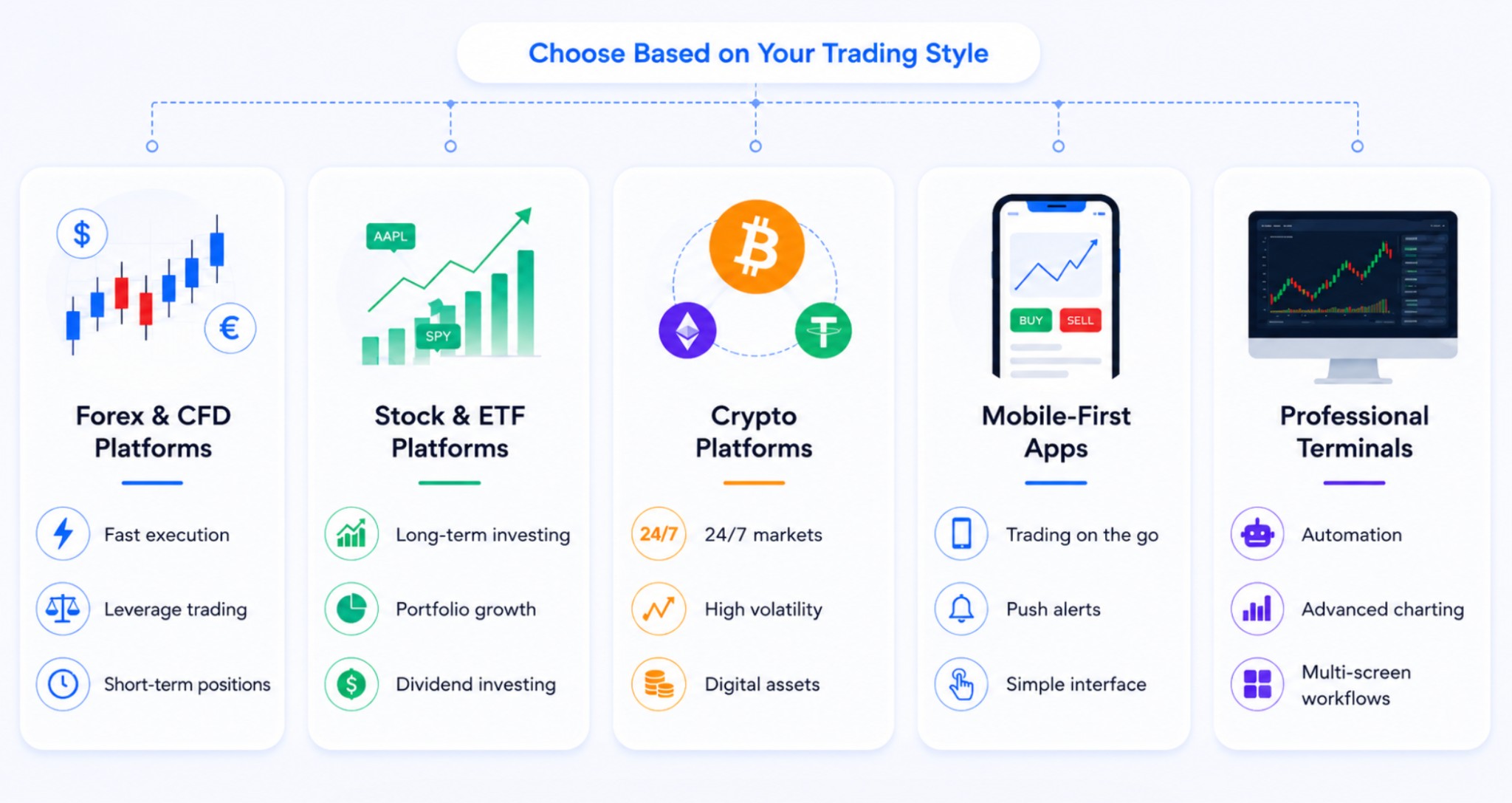
Some platforms are made for fast-moving, short-term trades; others are better suited for holding stocks for years; and a few are packed with professional tools most casual users will never use.
That’s why it helps to separate platforms by purpose before comparing brands or fees.
Forex and CFD Platforms
Forex and CFD platforms are trading platforms designed for short-term speculation on price movements across currencies, commodities, indices, and other markets.
Most traders in this category care about execution speed almost immediately. When positions are opened and closed frequently, small differences in spreads or order timing start becoming noticeable very quickly. Low latency helps reduce slippage for frequent short-term traders. A slow platform can turn a decent setup into a bad trade without much warning.
Leverage is also a major part of forex and CFD trading. Instead of paying the full value of a trade upfront, traders use margin to control larger positions with smaller deposits. That flexibility attracts many beginners because potential profits seem larger, though losses widen at exactly the same rate when the market moves against them.
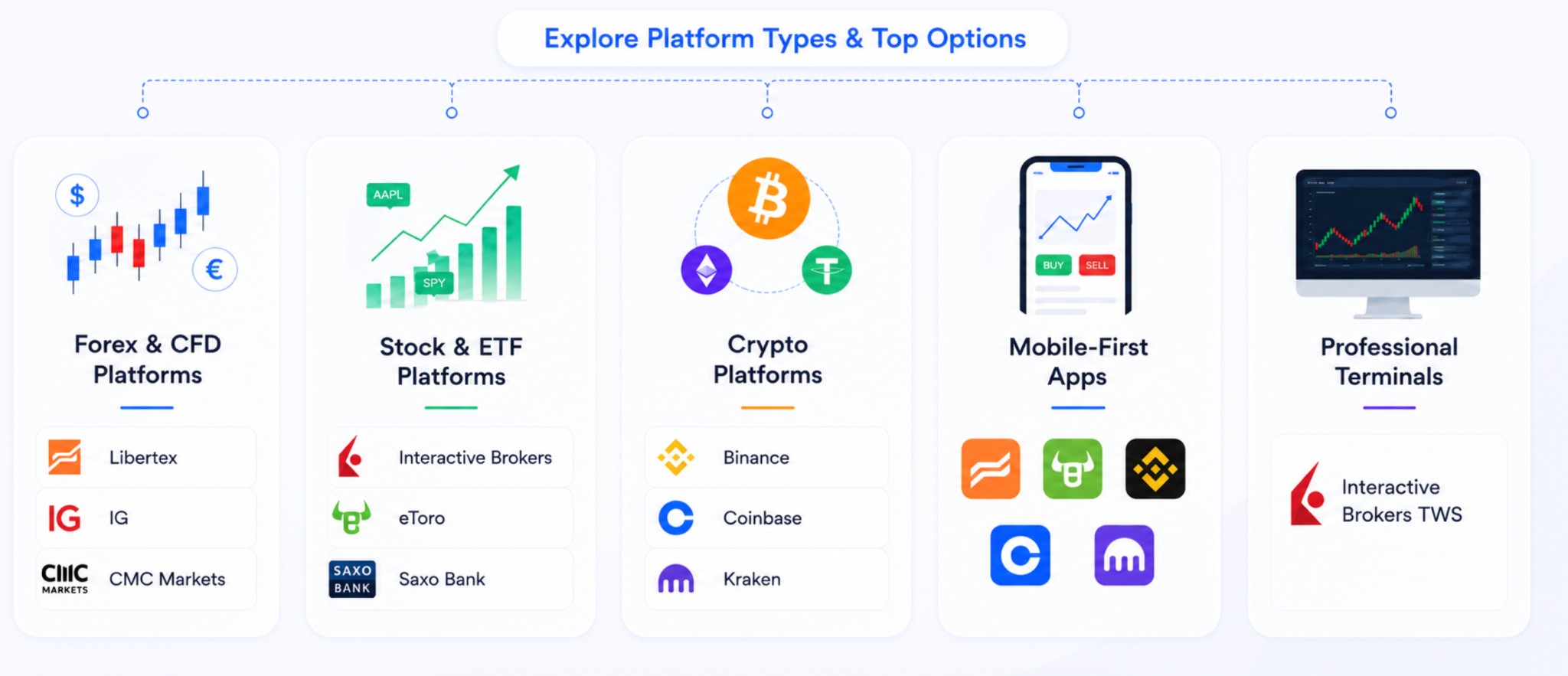
Libertex, IG, and CMC Markets are commonly associated with this category because they focus strongly on active trading functionality and multi-asset market access.
| Platform | Usually Known For | Main Market Focus |
| Libertex | CFD trading access | Forex, indices, crypto |
| IG | Research and analytics | Forex and CFDs |
| CMC Markets | Advanced charting | Forex and commodities |
Stock and ETF Investment Platforms
Stock and ETF investment platforms are designed for buying and holding real financial assets over longer periods, typically through investment or retirement accounts.
The mindset here is completely different from short-term trading. Investors are usually focused on gradual portfolio growth, dividend income, retirement planning, or long-term exposure to certain industries and regions. Some also compare these platforms to savings accounts when considering long-term goals, but their purposes and risk levels are very different. Positions might stay open for years rather than hours.
Interactive Brokers is popular with experienced investors because it offers access to a wide range of global markets and professional portfolio tools. eToro is often chosen by newer investors who prefer a simpler interface and social investing features.
One detail beginners often misunderstand is the difference between owning shares and trading CFDs. Buying a stock means owning part of a publicly traded company, so you hold the actual asset. CFDs track only price movements and don’t confer ownership rights in the traditional sense.
| Platform | Better Suited For | Main Strength |
| Interactive Brokers | Experienced investors | Global market access |
| eToro | Beginner investors | Simple investing experience |
| Saxo Bank | Larger portfolios | Wealth management tools |
Crypto Trading Platforms
Crypto trading platforms are digital marketplaces where users trade cryptocurrencies such as Bitcoin, Ethereum, and thousands of smaller digital assets.
This market behaves differently from traditional stock or forex trading. Crypto markets run around the clock, volatility is much higher, and sentiment can move prices aggressively within a very short period of time.
For some traders, that volatility creates opportunity. For others, it becomes exhausting after a while.
Binance is widely used by active crypto traders for its extensive ecosystem and broad range of assets. Coinbase is often considered easier for beginners because the interface feels simpler and less overloaded.
| Platform | Common Audience | Main Characteristic |
| Binance | Active traders | Large crypto ecosystem |
| Coinbase | Beginners | Easier onboarding |
| Kraken | Security-focused traders | Strong compliance approach |
Mobile-First Trading Apps
Mobile-first trading apps are platforms primarily designed around smartphone trading rather than desktop workspaces.
A few years ago, mobile trading still felt limited. That changed pretty quickly. Many traders now manage positions directly from their phones, especially in crypto and CFD markets, where quick reactions matter more than detailed research. Active traders should still evaluate charting tools and execution speed, while beginning investors often benefit more from intuitive mobile apps and educational resources.
The convenience is obvious. Traders can monitor positions, receive alerts, and place orders almost anywhere without sitting in front of multiple charts all day.
There are still limitations, though. Chart analysis becomes less comfortable on smaller screens, especially when traders use multiple indicators or timeframes simultaneously. Desktop platforms remain better suited for deeper technical analysis and larger workspaces.
Professional Trading Terminals
Professional trading terminals are advanced trading environments built for automation, large-scale analysis, and institutional-style workflows. Many of the top trading platforms appeal to advanced users because they combine customisable charts, real-time data, and access to market news.
These systems usually look much more complex than regular retail apps because they include tools that casual traders rarely need. The learning curve can feel steep during the first few days, especially for users moving from simpler mobile platforms.
Algorithmic trading is one of the biggest reasons traders move toward professional terminals. Instead of manually opening positions, traders can automate strategies using predefined conditions, scripts, or external models connected via APIs.
Interactive Brokers Trader Workstation is widely used by advanced traders who need deeper market access and institutional-style tools. MetaTrader 5 remains one of the most commonly used platforms among forex and CFD traders running automated strategies or custom indicators, with real-time data and streaming news helping support timely decisions.
| Terminal | Common Users | Main Use Case |
| Interactive Brokers TWS | Professional traders | Multi-market trading |
| MetaTrader 5 | Forex and CFD traders | Automated trading |
| TradingView integrations | Technical analysts | Chart-focused workflows |
How to Choose a Trading Platform
Choosing a trading platform means comparing far more than just the number of available assets or the design of the mobile app. The platform affects trading costs, execution quality, risk exposure, and how comfortable the entire experience feels once real money is involved.
Many beginners focus too heavily on marketing claims. “Zero commissions” sounds attractive until hidden spreads or inactivity fees quietly make the account more expensive over time. The opposite happens too. Some advanced platforms offer strong tools, but feel unnecessarily difficult for someone just learning how markets work.
The best approach is to compare platforms step by step instead of looking for a single “perfect” broker.
1. Check Regulation and Security
Regulation and security determine how well a trading platform protects client funds, handles risk disclosures, and operates under financial supervision.
Some of the most recognised financial regulators include:
| Regulator | Region | Why Traders Pay Attention |
| FCA | United Kingdom | Strong consumer protection rules |
| CySEC | European Union | MiFID II compliance and investor compensation |
| ASIC | Australia | Strict operational standards |
| FINRA | United States | Broker oversight and compliance monitoring |
One of the first things worth checking is whether the broker keeps client money in segregated accounts. Segregated funds mean that customer deposits are kept separate from the company’s operational finances, reducing risk if the broker faces financial trouble.
Compensation schemes also matter, especially for retail traders. Some regulated jurisdictions provide investor protection programs if a licensed broker becomes insolvent. The exact coverage depends on the regulator and country. US-focused readers may also want to verify that the broker is a member of SIPC, which protects securities up to $500,000 if the brokerage fails.
Risk disclosures are another useful signal. Reliable brokers openly explain trading risks, especially around leveraged products like CFDs and forex. If a platform hides those details behind aggressive marketing language, that’s usually not a great sign.
2. Compare Real Trading Costs
Real trading costs include spreads, commissions, overnight charges, inactivity fees, and withdrawal costs, not just the numbers shown in advertisements. When comparing stock-trading platforms, commission fees, account minimums, and security deserve particular attention.
This is one of the areas where many comparison articles stay frustratingly shallow. A platform advertising “zero commissions” does not automatically mean trading there is cheaper overall.
A platform with “zero commissions” may still charge wider spreads, which can be expensive for active traders.
| Cost Type | What It Means |
| Spread | Difference between buy and sell price |
| Commission | Fixed or percentage-based trade fee |
| Overnight fee | Cost for holding leveraged positions overnight |
| Inactivity fee | Charge for unused accounts |
| Withdrawal fee | Cost for transferring funds out |
Overnight fees catch many beginners off guard. Holding leveraged CFD or forex positions for several days can slowly accumulate financing costs in the background, especially during volatile periods or high-interest-rate environments.
Some platforms, including Libertex, use a commission-based structure instead of traditional spread-heavy pricing, which some active traders prefer for transparency and competitive fees.
3. Evaluate the User Interface
The user interface determines how easily traders can analyse markets, place orders, and manage positions without making avoidable mistakes.
A complicated interface is not automatically “professional.” In many cases, it simply slows people down.
For beginners, usability matters more than having hundreds of hidden tools they may never use. Navigation should feel straightforward enough that opening, adjusting, or closing positions doesn’t become stressful during volatile market conditions.
Some of the most useful things to evaluate include, especially when platforms also offer customisable dashboards:
- Chart readability
- Order placement flow
- Navigation speed
- Mobile synchronisation
- Watchlist organisation
- Alert management
- Stop-loss editing
Charting quality also varies more than most people expect. Some platforms offer highly customisable layouts with multiple indicators and timeframe combinations, including advanced charting tools and integrated market research for traders seeking greater depth, while others simplify the experience for casual users.
Mobile synchronisation became much more important over the last few years too. Traders often move between desktop and mobile devices throughout the day, so watchlists, alerts, and open positions should update in real time without creating inconsistencies.
Demo accounts are very helpful at this stage because they let traders test the interface under real market conditions without risking money, and paper trading makes it easier to test workflows before using real funds.
4. Review Available Markets
Available markets determine what assets a trader or investor can actually access through the platform, and depending on the broker, these may also include exchange-traded funds, mutual funds, and fixed-income products.
Some brokers focus almost entirely on forex and CFDs, while others provide broader access to stocks, ETFs, commodities, crypto assets, or international exchanges. A platform that feels perfect today can become limiting later if the asset selection is too narrow. More advanced brokers may also offer trade options, support efficient options trading, or include futures alongside stocks and ETFs.
The most common market categories include:
| Market Type | Examples |
| Forex | EUR/USD, GBP/JPY |
| Commodities | Gold, oil, natural gas |
| Stocks | Apple, Tesla, Nvidia |
| ETFs | S&P 500 ETFs, sector ETFs |
| Crypto | Bitcoin, Ethereum, Solana |
| Indices | NASDAQ, DAX, S&P 500 |
Some platforms also support fractional shares for smaller investors building an investment portfolio.
This matters because trading style often changes over time. Someone starting with forex may eventually want exposure to stocks or commodities. Another trader focused on crypto might later move toward ETFs or broader portfolio diversification.
Some platforms also provide access to US markets, which may involve foreign exchange considerations.
Multi-asset access is especially useful for traders who want everything managed from a single account rather than splitting funds across multiple platforms.
5. Test the Demo Account First
A demo account is a simulated trading environment that allows users to practice with virtual funds before risking real capital. After opening an account and adding deposited funds, traders can move from demo testing to live execution.
Skipping the demo stage is one of the most common beginner mistakes. A platform can look polished in screenshots and still feel uncomfortable after a few hours of actual use.
The goal isn’t just learning where buttons are located. A proper demo test helps traders evaluate how the platform behaves during real market conditions.
Things worth testing inside a demo account include:
- Execution speed during volatility
- Spread behaviour
- Stop-loss placement
- Chart responsiveness
- Mobile usability
- Alert functionality
- Order management flow
It’s also useful to test both desktop and mobile versions before depositing funds. Some platforms work smoothly on desktops but feel clunky on smaller screens.
Platforms like Libertex, eToro, and XTB offer demo environments that let beginners practice without risking capital.
Even experienced traders occasionally use demo accounts to test new strategies, indicators, or automated systems before moving them into live markets, and demo mode is also useful for testing trade ideas before using real capital.
Final Thoughts
There probably isn’t a single best trading platform for everyone, even though many comparison articles try to present it that way. Someone trading forex every day usually cares about execution speed, spreads, and chart responsiveness. A long-term investor will probably pay more attention to portfolio tools, research access, or ETF availability instead. People trading occasionally from a phone often want something simple that doesn’t require ten windows open at once just to place an order.
That’s why learning how to choose a trading platform matters more than chasing whatever app happens to trend on social media this month.
A few things tend to shape the decision more than anything else:
- How often you trade
- What assets you trade
- Whether you need advanced analysis tools
- How comfortable you are with risk
- If mobile trading matters to you
- How important educational tools are
- How the fee structure actually works in practice
Libertex is one example of a platform that sits somewhere in the middle. The interface is relatively approachable for beginners, but it still supports MetaTrader 4 and MetaTrader 5 for traders who want more advanced charting or automated systems later on. The platform also offers users a free demo account, which honestly helps more than many beginners expect once they start testing real market conditions.
FAQ
What is the best trading platform for beginners?
Libertex is often recommended for beginners because the platform is relatively easy to navigate, supports mobile trading, and includes a free demo account for practice before using real funds.
How do online trading platforms make money?
Online trading platforms usually earn money through spreads, commissions, overnight fees, and other trading-related charges. Some platforms advertise low or zero commissions while still generating revenue through spreads or leveraged trading costs.
Can I trade from my phone?
Yes. Platforms like Libertex offer iOS and Android apps that allow users to monitor markets, place trades, and manage positions directly from mobile devices.
What is the difference between MetaTrader 4 and MetaTrader 5?
MetaTrader 4 was designed primarily for forex trading, while MetaTrader 5 supports more asset classes, additional order types, and more advanced automation features.
Is Libertex good for beginner traders?
Yes, many beginner traders choose Libertex because it combines a relatively simple interface with demo account access, multi-device support, and compatibility with MetaTrader 4 and 5 for more advanced trading later on.
Not financial advice. The content of this article is provided by Libertex for general information and educational purposes only. It does not constitute investment advice, investment research, a personal recommendation, or an offer or solicitation to buy or sell any financial instrument or other asset. It is general in nature and is not tailored to any individual reader, so it cannot account for your personal circumstances, financial situation, knowledge, experience, or investment objectives. Any decision to act on this content is taken at your own discretion and risk, and you remain solely responsible for assessing whether a product or strategy is right for you and for seeking independent professional advice where appropriate.
Risk warning. Trading in financial instruments and other assets, particularly leveraged products such as CFDs, is complex and carries a high risk of losing money rapidly. Leverage magnifies both gains and losses, so small market movements can lead to disproportionate losses. The value of the assets referenced may rise or fall, and you may lose your entire invested amount. Past performance is not a reliable indicator of future results. The use of artificial intelligence, algorithms, automated strategies, or any other analytical tool in trading does not guarantee any particular outcome, does not eliminate risk, and does not replace your own judgement — you remain fully responsible for assessing every instrument, strategy, and decision, and for the results of your trading.
Why trade with Libertex?
- Get access to a demo account free of charge
- Receive live technical assistance 5 days a week, 24 hours a day
- Enjoy leverage of up to 1:500
- Use a platform for any device: Libertex and MetaTrader 4 and 5
- Pay zero commission on withdrawals in Latin America
- Benefit from up to $500 protection on your first trades with Negative Trade Protection